Making Clotted Cream
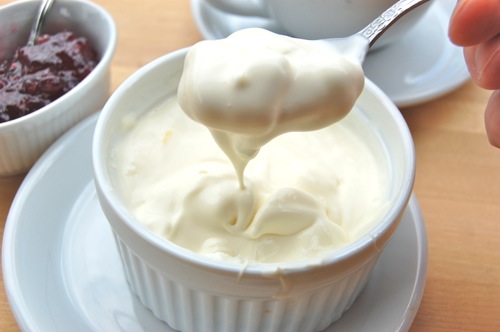
The texture of clotted cream is really unlike any other dairy product I’m aware of. It’s smooth, incredibly thick, full of big, curd-like blobs and just a little gooey. “Mud-like” is the term I usually use, and it’s apt.
For a one-time Devon resident like myself, the realization that I had the resources available to make my own clotted cream caused waves of both nostalgia and lust — butterfat lust — to wash over me. I had to rush out immediately and try it. If you have small, local dairy cream available to you (un-homogenized and especially un-stabilized) this recipe will be a snap. If not you probably won’t get quite the same result, but to my way of seeing things that’s no reason not to try. The potential rewards are simply too great.
Start by setting your oven at about 185 degrees Fahrenheit. Anything under 200 will do. Then pour about a quart of heavy cream into a small dish or pot. That there are already some clots of butterfat here indicates that this is definitely the sort of cream I want.
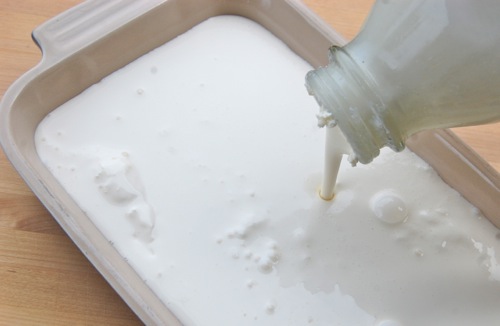
Cover that with aluminum foil (or a lid in the case of a pot) and place it in the oven for 10-12 hours.
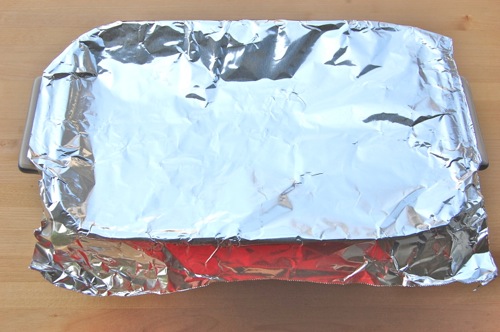
What’s going to happen in that time? Well, the steady low heat of the oven is going to encourage all the tiny fat globules in the cream to rise. As they do they’ll bunch up — though not combine with one another — to make a huge, thick mass.
You can see what that mass looks like when I take it out. Much of the fat (and a little butter, there) has risen to the top. However it’s still liquid. Turning this into clotted cream proper means cooling it. So into the refrigerator it goes.
What will happen in there? A couple things. The chill will cause the lipid molecules in the butterfat globules to form crystals. The whole mass will get firmer. That’s how it works in Devon and Cornwall at least. Will the same thing happen for me here in Kentucky?
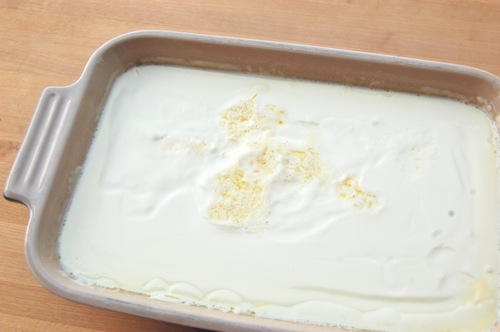
Yup.
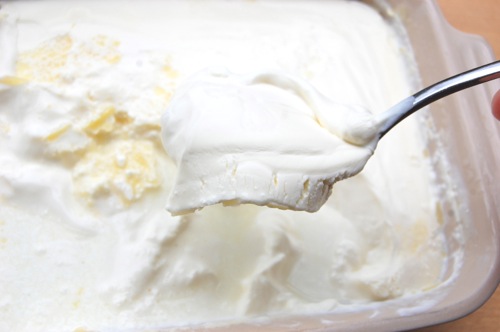
So I just skim off the big, firm clots and keep them in a bowl until I need them. The remainder I’ll strain and use as half-and-half in, well, whatever. Store this for a week or more tightly covered to prevent odors or off flavors from getting in.
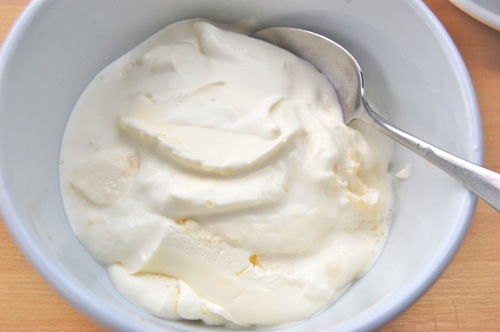
You’ll want to serve this chilled. Spread it on scones and consume with abandon. Large quantities are suitable for bathing in.
OK. I have only had clotted cream once. I bought a jar of it at a market in Los Angeles and, since it was the only time I’d seen it but not the only time I’d heard of it, I had to have it.
I went right home and made scones, put the cream on it and expected bliss (I’ve got English friends who’ve lived here for decades and still miss it). To my mind, it tasted like unsalted butter. And I feel about unsalted butter the same way I feel about Tuscan bread which is to say, “Fine. But now can I have the real stuff, please?”.
Is this a personal preference or do you think I’m basing my opinion on an inferior product? I simply have no way of knowing.
Hey Rainey! Glad you brought that up. Clotted cream in little jars is usually very firm. As you point out, it’s the consistency of butter. It needs to be stirred well in order to get it to its ideal mud-like consistency, because the consistency is a big part of experience. Depending on the flavor of the cream it was made from it can taste like butter. It can also have grassy or cheesy notes as well. Generally it’s completely delicious.
– Joe
Joe, I made your recipe using pasturized heavy cream, and it turned out great!! Imagine how it would have tasted if I had been able to use unpasturized cream! Keep up the good work!
Great news, Jackie! Thanks so much for reporting on the progress!
– Joe
No, don’t stir the clotted cream, there should be a crust on the top and the crust is the best bit!
Should clotted cream be sweet ? I have seen recipes where sugar is added…
in order to enjoy the extreme delights of clotted cream you need to butter your scone then add jam then the clotted cream and have an english tea and you will be in heaven strawberry jam is the best.
Hello Paul!
I remember most of that from my university days in Devon…I don’t remember the buttered scone, but I do all the rest. I also remember Devon cream ice cream cones which you could get near the cathedral yard in Exeter…they’d top every cone with a spoonful of fresh Devon cream. Lord I mess that place. Thanks for the memories, Paul!
– Joe
Thank you for the recipe Joe. Now I can make my own. As a Cornishman stuck in Israel I need clotted cream which should be enjoyed with plain or fruit scones lashings of salted butter with strawberry jam or bramble jelly, with as much clotted cream balanced on top accompanied by some decent tea with milk.
Tim, the way you talk about butterfat makes me miss the West Country terribly. I only spent a year of my life there, but I’ll never forget the clotted cream ice cream I was served in the Scilly Isles, topped with a big crusty dollop of clotted cream, just because. Best of luck with the project. You’re a long way from home, I hope this works well for you!
– Joe
I had no idea this would be so easy! Will this work at all with store bought heavy cream or should I not bother trying?
I don’t have a source for anything raw here in Vegas, I don’t think 🙁
It definitely shouldn’t be raw — I’m not into that because if the health risks — but can you find anything brought from a small dairy? Maybe at a Whole Foods? That would be the best. Otherwise I’d experiment with just a pint or so to see!
Good luck, Red from SS!
– Joe
If you start from raw cream, won’t holding it at just under 200F for that long pasteurise it anyway?
In any case – I live in farm country, there’s got to be somewhere around here where I can get some un-homogenised cream…I’m going to have to try this!
As a matter of fact it will! Well observed, Jane! And do try it, it’ll become a regular thing, I promise you!
– Joe
You could use raw milk. Heating it at 185° foe 10-12 hours will pasteurize it.
Thanks, Laurie!
– Joe
You probably have to say that to avoid liability, but raw milk products are generally very, very safe. You’re in more danger of being poisoned by your lettuce or your ground beef than you are of being suffering health problems from raw dairy.
Hey Cholla!
Thanks for the note! Since I’m not making money at this I’m not particularly afraid of liability, no. I’ve just know (and have known) a lot of folks who live on farms and around dairy cows and cattle generally. Few if any of them would ever dream of consuming milk in its raw state, and I think that’s for good reason. Two fellows I knew in college got seriously ill from drinking raw milk on their family farms. I think it’s a risk, but that’s my opinion. You are entitled to yours!
Cheers and thanks again,
– Joe
I made butter in a class a few weeks back by pouring normal store-bought heavy cream into a container (a juice bottle in this case) and shaking it a lot. (I think it took about 20 minutes, but I’m not sure because everyone in the group passed it around.) The instructor said it would go through several stages before becoming butter–one of these stages being clotted cream. (The stage just before butter, if I recall correctly.) Is this a possibility, or does she just not know what clotted cream is?
Hm. I’m not too sure about that one, Jordan. I referenced fat globules in this post. Those little things are surrounded by a membrane that’s made up of protein. Those membranes are quite tough…almost impervious to heat. Which is why, when heat is applied to the cream it doesn’t cause those globules to burst, but rather rise and clump together into a mass.
The agitation of the butter-making process, by contrast, rips open those blobs such that they end up spilling their load of butterfat molecules into the mixture. As the agitation continues those molecules find each other and begin to form crystals, which us what butter is.
So you really have two very different things, though they’re made out of the same things. On the one hand you have an agglomeration of millions of tiny fat blobs. On the other, a giant butterfat crystal. One isn’t really a step toward the other, at least as far as I know. Thanks for the question, Jordan!
– Joe
One of the stages is whipped cream, which is definitely not the same as clotted cream. I’m guessing the instructor is confusing the two.
Thanks Bronwyn!
– Joe
::says:: Oh! ::in a bit of a disappointed voice::
I was thinking that maybe someone used that process to make the commercial version of clotted cream that I took to be so butter-like.
My guess is not, but I could be wrong!
– Joe
This is how I make butter–the penultimate stage is, indeed, whipped cream, not clotted cream. Makes terrific butter, by the way.
Fascinating! Thanks Carole!
– Joe
You really need to try that, Joe. This is what Imentioned to you in email over the weekend. Beating cream and stopping when it JUST BREAKS from the whey yields a product much like commercial clotted cream. Call it unsalted butter if you want, but the difference isn’t great and the process couldn’t be easier.
Interesting I may give that a whirl (no pun intended) this weekend.
Cheers,
– Joe
I use this, mixed with equal parts lemon curd for every birthday cake I make. I use it to cover each layer and then frost accordingly.
Wow…FABULOUS idea, Linda! I’m definitely going to try that.
– Joe
Thanks! Must try this. Then I won’t have to smuggle the real stuff home in my suitcase anymore 🙂
I tried that once…with messy results.
– Joe
Thank you! I now have project for the weekend… Joe, you’re the best!
Let me know how it goes, Mark!
– Joe
As a former resident of Somerset, I heartily agree that this is a lustful foodstuff.
Phwoar!
When this whole discussion first arose I got excited and purchased a pint of heavy cream starting the “cook to clot” process with half and reserved the other half to make cream scones. After many hours the cream just wouldn’t clot. Turns out even my local Whole Foods only carries ultrapasteurized cream which further discussion indicates will never reach the desired consistency. I did a few more searches and came across the suggestion of adding 1/4 cup cream cheese to a cup of heavy cream with the rest of the direction identical. While I suspect I just cooked up a batch of ultra-mild cream cheese, the consistency and flavor were spot on. We do have a few local dairies (actually 30 minutes away at closest) so I have hopes of going legit. In the mean time I’ve got a good batch of something nice.
James, that sounds like an excellent stop-gap solution. Let me know when you get the right milk for the project as I’ll be keen to hear if you think there’s a big difference between the two. Cheers,
– Joe
I’m not 100% sure about this, but I think I’ve read recipes for making clotted cream that involve adding ordinary cream to homogenised milk, and as the cream from the cream rises it sort of attaches the tiny cream globules from the homogenised milk. It sort of makes sense, but I’ve not tried it.
In a mini (if incomplete) side by side taste test we pitted my home made clotted cream (w/cream cheese activator) against a store bought, imported jar of Devon Clotted Cream (not cheap). The tastes were remarkably similar with the home made version slightly sweeter. The textures were remarkably different. Home made was a very thick, spreadable not-quite-liquid paste. Store bought was a soft, butter like texture. With no respect for authenticity, both my teen daughter and I had a clear preference for the home made. I will not likely have a good opportunity to try the “authentic” non-cream cheese method for a few months but I will try when I get the chance.
I guess a quick summary is, if you can’t get raw cream, throw in a 1/4 cup of cream cheese and soldier on. It works and you may like it better.
Sounds fair!
– J
Let me know what you think, James! I’ll be interested. Now me, I don’t think the stuff in the jars bears much resemblance to the real thing. The home made stuff using fresh cream is spot-on at least as far as I can remember. But do check back in and tell me what your conclusions are.
– Joe
I just emailed Whole Foods today to request heavy cream that was not ULTRA-pasteurized. I looked on line and Organic Valley makes both kinds in their line of heavy cream. WF got back to me this afternoon and indicated that Promised Land also makes what I want. They have ordered a couple of cases to put on the shelf.
You have to go through several steps on the WF website to get to where you can actually email them. I brought this item up in the store in the past and never had much luck. The email worked much better for me.
What about a crock pot? Would that hold the heat at the right temp? I live in a hot climate and try not to use my oven much when the temperature is over 100. Which it is, sadly.
Ingenious, Julie! I don’t see why that wouldn’t work. It may indeed be the perfect vessel for the job. Let me know how it goes!
– Joe
I’ve also heard of making yogurt by bringing the milk to the proper temperature and then pouring it into a thermos bottle that has been rinsed out with hot water to hold the temperature over and extended period.
I think a good stainless steel thermos bottle is supposed to hold heat for a couple hours. I suppose there would be some loss of heat but I wonder if that would be a problem. I mean many of these foods originated before people had the technology to be as precise and clinical as we attempt to be.
But if you ever decide to perform that experiment I’d suggest a wide mouth bottle so you can conveniently get out all the thick goodness. ; >
Interesting idea, Rainey! I don’t see why that wouldn’t work, actually…and a whole lot cheaper than a proofer or sous vide cooker. I’ll try that!
– Joe
I knew you would deliver, Joe! I was wondering how I could deliver the scones to my friend without including clotted cream, but no more 🙂 Excited to try it with her!
Thanks Ann! Have fun!
– Joe
In Gruyère, they have a speciality called “crème double” (double cream). It’s also very thick and spreadable, and is traditionally eaten with berries and/or meringue. What’s its relationship to clotted cream?
Hello Kristen!
I’m aware of Swiss double cream. I don’t think it’s made by the same process as clotted cream, but it is at least 45% butterfat. That’s a higher proportion that even the stoutest dairy cow can deliver, so there must be some sort of method for concentrating the butterfat, I’m just not sure what it is! Thanks for the question,
– Joe
The hippie dairy farmer I sometimes get raw milk from got a bit too enthusiastic with his new cream separator and produced something that needed to be spooned. Separator being nothing more than a centrifuge, the harder you spin it the more milk is spun out and the more concentrated the butterfat becomes. I’m guessing that all of the different fat % creams are just made by different speeds of separation.
I am blind guessing, but I wonder if it might be achieved by repetitious heating and cooling episodes. Wouldn’t that create a thicker net of sorts that lifts more of the butterfat as it rises to the top?
That’s a very interesting idea, Dani. I honestly have no idea if that would help or not. I’d be very interested in hearing the results of your experiment, however!
Keep in touch!
– Joe
Why doesn’t the cream spoil?
Hi Lynn!
Of course cream does spoil, it just takes longer. The reason for that is all the fat. Microbes that commonly infect milk are fond of sugars (lactose) and to a lesser extent proteins. However they don’t digest fat well, and cream is very fatty. That’s the main reason. Butter is another good example of this idea at work, as are French conflts (fat preserves). Fat in general tends to slow down the growth of tiny critters.
Thanks for the question, Lynn!
– Joe
Any idea what the final temperature of the cream is right out of the oven, before cooling? I might want to experiment with making it in my sous vide. Thanks!
I was wondering about that myself, Amy, preparing this sous vide. There really isn’t a “final” temperature with clotted cream, rather it needs to hold at a temperature above 175 F but below boiling for at least six hours. Let me know how you experiment goes!
– Joe
Thanks for the info! Just figured that the cream would never actually get anywhere near the 185 degree oven setting. But I guess w/ such a low temp oven over 10 to 12 hours, the cream might make it to 175 for six hours. I might try the oven method first, measure temp of cream when it’s done, and then use that reading as the setting for the sous vide. I’ll let you know how the experiments go!
Ah, I see what you mean now. You’re probably right on that, with evaporation and such it probably won’t hit peak heat. But I never really thought to measure. Ultimately I don’t think there’s a perfect temperature for this, so long as it doesn’t boil. Let me know what you determine, as I’ll be curious.
– Joe
Will do. Sorry to bombard you w/ questions (on a holiday no less!), but I do have one more. I can get unstabalized but not unhomogenized cream. Reading your entry about what happens to cream upon freezing, if I froze my cream before “clotting”, would this essentially give me unhomogenized cream for clotting? I think I have a lot of cream to buy 🙂
Hi Amy!
And it’s no problem. You can certainly try the unstabilized cream, though as a previous commenter mentioned, you’ll get a thinner product. As for freezing, it definitely won’t help the clotted cream cause, because you want all those little globules intact. Freezing is hell on those things!
Let me know how it goes!
– Joe
What we need (and I’m sure it’s available) is a thermometer with a wireless connection and a computer program to monitor the temperature of the product over time. It must include proper graphical software, of course. (This is my inner chemist talking.)
Currently in possession of two types of cream: both from local dairies, both free of stabilizers; one homogenized; one unhomogenized. Let the experiments begin! There will be thermometers involved 🙂
Oh, I cannot wait for this. Please post the results here in the comments section when you have them, so that posterity can benefit from your careful research!
– Joe
Okay; my experiments are over, and the results are in. They are surprising! The first question that I wanted to answer was about temperature. How hot does the cream actually get during its extended time in the oven and how long does this top temperature last? I’d assumed that it wouldn’t get anywhere near the 185 degrees Fahrenheit of the oven and worried that it would not even get hot enough for pasteurization temperatures (for those who wanted to start with raw dairy). I was very wrong. The cream was reading 170 degrees at the two hour mark. At hour three, the cream was 175, and was over 180 by hour six. At this point, I turned the oven down to 180 and the temperature hovered around 175 until I removed the cream at hour 10.
Using the oven temperatures as a guide, I next tried to replicate this in the sous vide. I poured the cream into a 1.5 lb loaf pan, placed it in the sous vide, and filled it with water to just under the top of the loaf pan. I also pressed a piece of plastic wrap onto the surface of the cream to prevent the water bath’s condensation from diluting the cream. With the sous vide set to 180 it took three hours for the cream to reach 180. I then held it at 180 for 8 hours (a total of 11 hours for the sous vide method).
After cooling overnight in the fridge, both methods produced clotted cream. However, there were some differences in consistency and yield. The oven method produced much thicker clotted cream with a higher yield. But the oven also produced more “butter” chunks in the final product. The sous vide produced 1/2 the amount that the oven did, but it was the “muddy” consistency described above.
In both the oven method and the sous vide method, I used two types of cream. Both were free of stabilizers, both were from small nearby dairies, and both were “gently” pasteurized. However, one was homogenized and one was not. In the oven test, the “thickness” of the resulting clotted creams were virtually identical. The difference was in the amount of “butter” chunks that each yielded. The non-homogenized cream left a very chunky product. There were fewer chunks in the homogenized clotted cream. I preferred the homogenized. The gentle “wet” heat of the sous vide seemed to eliminate this butter chuck problem, but as noted above, had a much softer texture and lower yield. The homogenization variable was basically irrelevant in the sous vide.
The biggest surprise for me, though, came from a variable that I did not think about when I started. the non-homogenized cream came from grass-fed cows. The homogenized cream came from cows fed some grain. The non-homogenized grass-fed cream produced clotted cream that was so grassy, so gamy, so barnyard-y, that it was inedible. The flavor actually turned my stomach. The homogenized cream, on the other hand, made clotted cream that was sweet with hints of caramel. It was thoroughly addictive.
To conclude, oven or sous vide, either will work. Just make sure the sous vide cream is kept at 180 degrees for at least 8 hours. Oven clotted cream is thicker and there is more of it. You can use homogenized or non-homogenized, but I preferred the texture of the clotted cream from the homogenized cream as it was smoother with less “butter” chunks. Finally, don’t overlook a label that touts “grass-fed.” When this flavor gets concentrated, it’s not pleasant. I’d steer clear (no pun intended).
You’ve performed a great service for posterity here, Amy! Thanks very much.
The results are fascinating indeed. In regard to the grassy, cheesy flavor, batches of clotted cream vary according to the input no question. Some people really like that cheesiness. I’m one of them!
Thanks so much!
– Joe
You are very welcome! It made for quite a fun weekend 🙂 As for the grass-fed cream, I wish I could say it was “cheesy.” Unfortunately, the flavor was more of manure. Blech! (That’s not to say that all grass-fed cream will taste this way or that the brand I used will have the same flavor at another time of year.)
Hm. Well, that’s the way it is with pasture-fed cows. The localvore crowd would have you believe that every drop of fresh pasture grazed cow’s milk is nectar of the gods. Obviously that ain’t always so, as you point out, depending on the time of year and what’s growing in the pasture! Commercial dairies have their uses!
Thanks again for all the hard work!
– Joe
Great experiment, Amy. I just wanted to add a note about homogenization. I’m not sure why it tasted bad for you but I would definitely go with unhomogenized cream as homogenization destroys the nutritional value of the fat globules. In fact, I have no idea why anyone would homogenize cream – I thought homogenized milk was done just to keep it all, well, homogenized during use. That is, keep the cream evenly spread through the milk. I can’t think why that would be done with cream.
I’ve tried the stove top method and the oven method so far. I didn’t get as much clotted cream as I expected, each time. But it seems I needed to repeat the whole process. I don’t really like using the oven for that long, though, so I may try the indirect heating method that Joe mentioned in his description of clotted cream.
What we had was pretty nice though. With the stove top method, I used raw milk and was left with a fairly creamy pasteurized milk. So I used it to make yoghurt. It was much less tart than my usual yoghurt and a much darker colour. Interesting. The oven method just left lighter cream (I used all cream in that attempt), which I added to some ordinary raw cream to make butter. Great stuff.
Hi Tony!
Just to answer that question: cream is homogenized precisely to eliminate “clots”. When people see those plop out of the cartons, they often assume that the cream has spoiled and return it. In fact, heavy cream is one of the most returned items in grocery stores. So that’s the reason. It’s unfortunate, but it’s reality. Thanks for the comment!
– Joe
Ah, to stop the clots. Thanks Joe. I live in New Zealand and I don’t think I’ve ever seen homogenized cream. It’s unfortunate, as you say.
Yes, most people here in the States have been off the farm for two generations at least…they see those little clots and start to worry. Sigh.
– J
So I tried making clotted cream at home but I think my oven temperature is too hot so the cream actually caramelized. It didn’t really “clot” either.
So I thought the whole thing was a disaster but it actually ended up tasting SO delicious. Too bad the texture was awful. Oh well, it didn’t go to waste!
http://samanthamenzies.com/home/2012/05/homemade-clotted-cream/
Hi Samantha!
It sounds to me like it worked just fine. Having lived in Devon (and visited Cornwall quite a lot) I can say that you frequently see lightly browned spots in clotted cream…and wow are they good! Clotted cream is known for its uneven texture, that’s part of the appeal. So I say: call it a success and enjoy it!
Thanks very much for the note!
– Joe
Yes! Validation is so sweet.
Thanks Joe
It has a high butterfat content also! 😉
Cheerio,
– Joe
I’m making this today! I am joyfully anticipating my first taste, ever. I don’t even have to be disappointed that it’s not in England–or Devon, for that matter–because I know this will be some LEGIT clotted cream. 🙂
You will be amazed, Ann. It’s different that any dairy product you’ve ever tried. Combined with jam, well, it’s quite simply nirvana.
Get back to me with a report!
– Joe
Joe, the report is unfortunately not good. Mine turned out like Samantha’s above, although it was VERY browned and hard on top, with no beautiful soft clots of cream. Just the half-and-half liquid on the bottom. I even got the special non-homogenized cream like you said! Not to worry, however. I am definitely trying this again at a lower temperature because I am determined to try clotted cream!
Dang! Reader Henry’s cream turned out the same way. Was it covered the whole time?
I will say that caramelized spots are common in the real thing…but no clots….that’s distressing. Please keep me updated!
– Joe
I’ve tried making clotted cream this weekend and I must say, it worked better than I expected. I wrote a blog post about it, which can be found over here: http://homemade-by-ena.nl/homemade-clotted-cream-the-ultimate-lemon-curd-and-scones/
And I think that the temperature is really important when making clotted cream. If you leave it too long for too hot in your oven, it will caramelize or burn, and I guess that at that temperature, the fat globules will explode as well, so no nice layer of clotted cream… So checking/monitoring the temperature of the oven with an oven thermometer would probably help.
I made clotted cream yesterday from Twinbrook Dairy’s 100% Jersey cow cream, from QFC in Seattle area. it is pasteurized and homogenized, but not ultra- pasteurized. it has a lovely, warm golden color to begin with. I poured a pint into a ceramic pie plate and stirred in 1/4 cup plain whole milk yogurt. I left it uncovered in oven for 8 hours at 180 F. then I refrigerated it in the plate for 8 hours. I turned it into a bowl, whipped it briefly (30 seconds) with the whip attachment of a blender stick, and then chilled again in a crock. it was perfect, exactly like the clotted cream I had at the Grand Cafe in Oxford last week–golden, thick, dense, spreadable. I’m going to try to freeze it.
Wow, Beth. Very interesting process. I’ll have to try that one, thanks!
– Joe
Ok so then the next question after all this wonderful experimentation. Can I jar and preserve the cream? Seal it in sterile jars and “process” them for storage in boiling water? Will the cream stay good? It’s hot enough to be bug free but will it stay stable in a jar like jam? Is his how store bought cream is stabilized or do you think the temperature is too high and will affect he product.
Hi Russ!
Clearly Devon cream can be canned, since we see it jars in import shops. However I don’t know if it can be done easily at home. Obviously it’s fatty and a little acidic, but not acidic enough that it can be safely canned in a boiling water bath. Probably you’d need a pressure canner, but I’ll need to investigate that a bit. Let me look around and see what I can find.
– Joe
If you have ultra-pasteurized cream, do you think adding citric acid could work?
I don’t think there’s much you can do when it’s ultra-pasteurized. The acid will just form curds, which isn’t what you want in this case. All of which is not to say you won’t make a very nice mascarpone with it! 😉
http://joepastry.com/category/pastry-components/dairy/mascarpone/
Let me know how it goes!
– Joe
Oh, I could happily drown myself in this. If ever there was a food item I loved more than bacon…*sigh*
I hear you, Doc, I hear you. Thanks for the note!
– Joe
Ice Cream for the low-carbohydrate enthusiasts of this post:
8 ounces of refrigerated clotted cream
2 tbsp of erythritol (or 1 generous tbsp of Splenda)
1 tbsp of vanilla powder
1 tbsp of refrigerated whipping cream
Combine and stir all ingredients vigorously, adding the whipping cream towards the end of your stirring. Enjoy!
Thanks Craig!
Hello Joe!
this was fun. i used raw milk for my test.
i wasn’t looking forward to leaving the oven on for 12 hours, so i took a chance and put the container in a dehydrator for about the same amount of time.
i think it worked!
i’m still figuring how to use up the half-and-half left over, but the resulting clotted cream was a real treat–intense cream flavor and an odd but still-appealing goopy texture. i’m guessing it’s all about those long protein molecules?
anyway, good show, thanks for this!
Thanks Bryan, it’s my pleasure. Congratulations on your success using that method…I’ll remember that!
Cheers,
– Joe
whoops, i’m getting my other dairy experiments confused.
i did use raw cream here. now that is a treat.
Wow…where do you live?
– Joe
I’m in the Bay Area, SF. There are some not-too-distant dairies who sell raw cow’s and goat’s milk as well as cream at our local Co-op.
It’s pricey stuff, but i don’t care, my cultured dairy products have never been more delicious.
If you really, truly trust the product then go for it, Bryan! I myself don’t think I’ll ever roll the raw dairy dice. But I believe you when you say they products are incredible. Thanks for the comment!
– Joe
I’ve been craving clotted cream like nobody’s business of late, and figured I’d look into making my own since it’s so expensive to buy. I am pleasantly surprised at how easy it seems to be! One thing I’m wondering is about the dish I would have it in. My one large casserole type dish is stoneware – not the ceramic-lined kind, but the rough stone kind. Would that make any kin of difference? I wouldn’t think so, just wanted to check.
As long as the interior is glazed and not porous it’ll be fine, Pippa. Have fun!
– Joe
Just tries this recipe with cream from our local dairy, but the taste is a little off. They stabilize the cream with corn starch, carrageenan, and Guar gum. The resulting clotted cream has a good texture, but a strongish chemical taste. I suppose this is due to the stabilizers.
I’ll have to look for another supply because the process is so easy! Thanks for helping us get the taste of high cream tea to the States!
My pleasure, Jeremy! Good luck with the search. The process does concentrate flavor, so every clotted cream tastes a little strong (cheesy, etc.). I’ll be curious to know how the new stuff tastes!
Cheers and thanks for the note!
– Joe
Your photos don’t look quite right. Clotted cream should have almost a buttery crust on the top in my experience, whereas your top looks quite liquid?
Maybe it would be better to cover with greaseproof paper rather than foil? Aluminium foil is a relatively modern material that would not have been around in years gone by?
I recall trips to Devon and Cornwall over 30 years ago, when you could visit shops and farms and they would scoop the cream out of big cooking trays. Back then you could have it put it into metal pots and sent by post to friends at home, as it was only available to buy in those counties.
Modern hygeine regulations seem to have killed off this cottage industry. Todays clotted cream is made in factories, shipped all over the country and priced as a luxury product. In my view it lacks some of the texture and flavour of the traditional product.
So I would be very keen to try making my own, if I can find a source of very fresh and unprocessed cream.
Hi Gavin! I’ve seen those trays! I lived in Devon in my university days and loved it. It’s true a lot of the farm producers got crusty tops on their, but I haven’t been able to replicate that here in the States, no matter the covering. However the results are awfully good. Not exactly Devon, but close enough for a fellow living a thousand miles away!
Cheers,
– Joe
Joe:
Your recipe and instructions work perfectly.
I can report that pasteurized whipping cream will indeed work, as long as it is not “Ultra” pasteurized (UHT). I live in Alberta, Canada, and the dairies here sell what is termed “High Temp Short Time” (HTST) pasteurized milk and cream. This means it’s heated to about 170 F for 10-15 secs. That doesn’t kill all the goodies in the whipping cream needed to make clotted cream. On the other hand UHT pasteurization heats the cream to around 275 F for at least one second. That type of cream very probably wouldn’t do. However many, if not most, dairies simply use the HTST method – so ask your grocer/dairy to confirm it and then use their product to make this delicious treat!
And of course, if you want more info on pasteurization just check with Google!
Great stuff, Dave! Thanks very much for the information. I think a lot of readers will be interested. Very glad it worked for you!
– Joe
Hi Joe,
I’m so glad you’re responding still to the comments on this recipe! I had to try this, did so, and the flavor is amazing. It’s really unlike anything I’ve ever had before.
I did notice that after I cooked and chilled mine, I scooped the globs into a jar, stirred until the consistency was smooth, then refrigerated it for storage. Now when I take it out to use it, it’s like hard butter. Tastes great, but it’s pretty firm.
You mentioned in an earlier comment that it needs to be stirred to overcome the butter texture. I’m assuming that there will be some firming up no matter what when you refrigerate it for storage, so is the “mud” texture supposed to be what it’s like when you take it out to use it on, say, day 2? Or when you stop stirring it before storage? I guess I’m just trying to clarify what the texture is supposed to be like when you use it on day 2, 3, etc.
Also, could cooking it too long cause it to firm up too much? I had mine cook for 10 hours at 180 degrees (my oven runs a little hot).
Thanks so much — you’re obviously very knowledgeable about this!
Ellen
Hello Ellen!
So glad you tried this and had good results! It’s really one of my favorite indulgences. It may become one of yours as well!
Concerning your questions, clotted cream behaves very much like butter when it gets cold. The fats start forming up into crystals and it gets harder. Letting it sit out before you use it will soften it considerably, so don’t worry that it’ll remain too firm to spread. Concerning the heat, no, it won’t cause hardening. In fact too much heat can cause the butterfat blobs to rupture, resulting in a liquid-y yellow mush that’s not nearly as fun to eat!
Sounds like you did it just right. A little sitting (or maybe some short zaps of five seconds or so in the microwave) will return it to a spreading consistency.
Thanks for the comment!
– Joe
Hi Joe,
I have my 2 pints of cream in the oven right now but the lowest setting on my oven is 200 F. Will it still work? Should I plan on turning my oven on and off to try to keep it at 180 for as long as possible?
Hi Joe,
I am planning to make my own clotted cream. When it is store-bought it is put in jars that are shelf stable, like if it were canned. If I decide to make a large amount of clotted cream is there a way that I can “can” it at home?
Hey Patti!
That’s tough question. It will keep for quite a while in the refrigerator, well-sealed so it doesn’t pick up off flavors. It doesn’t freeze, but it probably can be canned, provided you have a pressure canner, since it would be a low-acid food. It’s been a while since I’ve done anything like that, but there are canning resources on the web that could probably tell you how to do it.
That’s the best I have for you this morning, Patti!
– Joe
I have the cream in the oven. We are looking forward to scones with clotted cream and jam on Easter morning! It was very nice to find that it is easy to make. The cow came fresh three weeks ago so it is always nice to find new things to do with the extremely abundant supply of milk!
Wonderful, Racie! Talk about an Easter morning treat! Let me know how it turns out!
– Joe
Well Joe,
You’ve ruined me! Our family was celebrating my aunt’s 75th birthday with a tea party. I made your clotted cream, cream tea scones, and threw together your recipe(s) for a St. Honore. Oh, Joe! Now I must have these tasty items all the time. With just a few ingredients, a little mixing here, a little oven time there, and Voila! there is ambrosia to be had. All kidding aside, I thank you Joe. It was so easy, and came out so well, I don’t know why I didn’t do it before.
One little thing about the clotted cream. I tried it twice. The first time was just using one pan, it was a ceramic baker. It didn’t come out all that great. I didn’t let it stop me. I tried it again. This time I doubled my efforts, using the same ceramic baker and also a glass baker. The ceramic baker was okay, but not great. The glass baker came out fantastic! Same amount of cream, same oven, same time. From now on, all my clotted cream making will be done in glass bakers.
Thanks Joe
OMG!!!! I’ve died and gone to heaven. I just completed making this and can I say I can’t make my scones quick enough. I’m salivating waiting to take my first bite with all the layers that belong on a scone. Butter-clotted cream-then topped with jam. Thank you for sharing this brilliant taste of home.
So glad to get this message, Anita! It really took me back to Devon, glad it took you back as well. I hope the scones are done!
– Joe
Hi!
I’m originally from England but have been living in the US for the past 4 years and was VERY excited to find this! I tried it yesterday, found the right cream, put it in a pot with a lid and in the oven for 12 hours. Straight in the fridge for 5 hours and I still have milk with what looks like a layer of butter on top?! What did I do wrong?! Please help!!
Thanks 🙂
Hey Rachel!
Was it a for-real pot? If the cream was more than an inch or so deep, that was probably the problem. The high sides probably didn’t help either. I’d suggest taking the butter off (for indeed that’s what you have there) and try it again. It may be a bit of a long shot, but it may be a way to salvage the cream.
Sorry it didn’t work out the first time, Rachel!
– Joe
Hey Joe,
Thanks so much for your reply. It was a 6 quart cast iron pot with lid. The sides were quite deep. I actually used it to make a killer rice pudding 🙂 I have another lot on the go now though.
Thanks for your help! 🙂
Let me know how it goes, Rachel! We’ll get this problem solved. I can’t stand to think of a clotted cream lover going without. I did for too many long, lonely years…
– Joe
Hi Joe,
Thank you so much for posting this, and to everyone for posting their experiments and outcomes. I had been buying the jarred shelf stable kind as a treat, birthday, Christmas and such for years. Then I went on holiday in Cornwall with a friend a few years back, and had Rodda’s brand, and also clotted cream ice cream, and some handmade local outside of Mousehole, right out of a flat pan from a dairy farmer there (the best I have EVER had). It is bliss to me. It also ruined the over-priced shelf stable jar to the point that I won’t buy it. In comparison to what I had in Cornwall, it is just really horrible. There are some local farms when I can buy raw cream and milk nearby. I drink the raw milk, and love it. Anyway, next trip out there I am going to buy some cream and give this a go! So excited, I miss clotted cream way to much. So, here is my silly question. If I used a quart of raw cream, non -pasteurized, non-homogenized, roughly how much clotted cream would come of the quart? Thank you or anyone who can advise me. The kinds I had in Cornwall all had a top layer that was a pale yellowish color, and formed almost a crust across the top, that you would tap into with the spoon and under that the thick mud like clotted cream to the bottom of the tub that was less yellow. TUB, yes, that is the part that broke my heart the most, you could get a plastic tub of it at any grocery for under 2 quid. That tasted like the heaven on earth that it should. After that, looking at the blue labelled jar of shelf stable Devon Cream for $12 usd, yeah, nope, will never buy that again. I will take some pics and let you know how my experiment turned out. Thanks again!!!
http://www.roddas.co.uk/recipes/scones-with-cornish-clotted-cream-and-strawberry-jam This is the brand I was devouring in Cornwall, there is a nice video that shows that yellow crust bit going on. Good visuals to see what it should look like.
Thanks, Barbara!
– Joe
Hi Barbara! It is my very great pleasure! Thanks for the note, and yes, the clotted cream in a jar is nothing compared to the real thing…or the homemade thing (even if it’s not quite the same).
As for how much clotted cream you’ll get, that really depends on the cream you buy. Assuming it’s around 30% butterfat, you’ll convert maybe 40% of the total volume of the cream to clotted cream.
Let me know how it goes!
– Joe
My brother just brought me a gift of a gallon of raw milk from PA, YEAH! No shops in MD have cream that is not ultra past., it seems to be the law. So Tomorrow I will commence the experiment 🙂 Looking at the gallon in the fridge, it is separated, I would say about 3- 3.25 cups of cream on the top. We will see, so excited for my little kitchen science experiment. I did call the dairy in PA that sells the raw milk, they are not allowed to sell cream unless U.P. either, so if I want to do more he will let me go in, and pour my own milk off their excess 😉 YES! Sad thing is they are throwing away about 30 gallons of great raw milk away every 2 days. So sad! Will take notes and let you know how it went 🙂 Thank you Joe Pastry!!!!!
Barbara! How did it go?
– Joe
I haven’t tried your method yet, but will in the very near future… have to make my strawberry jam first; wouldn’t want scones and clotted cream without strawberry jam, or worse, store bought jam. Anyway, I wanted to commend and thank you for continuing to respond to comments on this post.
Canning clotted cream is probably not a good idea. There are several issues (breaking, texture, racidity, encapsulation of bacteria by fat molecules) regarding home canning anything that contains dairy products. Although you can find canned clotted cream commercially available, the process and equipment used is different from what a home canner would use. I also wonder about any additives. I only found label information for one type of jarred clotted cream. It claimed to only contain pasteurized cream on the ingredient list… I find this to be not quite believable.
When I lived in Denver, all the major grocers carried Devon Cream. So I retired to Pueblo and none in stock anywhere. I whined about this to a friend and she told me to add a quarter cup of powdered sugar and a pinch of salt to a pint of heavy cream, pour it on a cookie sheet and bake for 14 hours at 180. I used ultra pasteurized cream, and my oven shuts off at 12 hours, but it came out wonderfully. I wanted to make it again, but I couldn’t remember the oven heat, so I checked in here for it. Have the scones. Will enjoy tomorrow.
Powdered sugar you say…fascinating! Very glad you dropped by. PLease come back soon!
– Joe
Thanks Joe for all of your information to made clotted cream on the other side of the pond! My sister was recently in London and sent me a canister of clotted cream shortbread from Highgrove – as they say, to die for. The first recipe I ever made was shortbread in home economics class at Rutherford Grammar in Newcastle Upon Thyme in 1965. I have researched recipes and am determined to make the clotted cream version of my nostalgic shortbread! Since I live in a rural area of Louisiana it’s a bit of a task! Thanks again Joe for your contribution!!
PS had to handwrite your method. When hitting “print,” the printer of course started at page 26. Then it ran out of paper before finishing. I accidently hit the power button to restart and it turned off instead- never resuming or completing. A printable version of your method would be nice!
Hey Bobbie!
Let me know how it goes. And yes, printable pages is something I have on my wish list for the next iteration of Joe Pastry.
Cheers,
– Joe
Joe, this information is the best on the internet, thank you. We can get what you call heavy cream (we call it double cream) easily here and I will try your method very soon. I just had to comment though that traditionally you don’t butter the scone – pile it high with clotted cream, make a dent in the middle and add a big dollop of jam (strawberry is best). It is obligatory to take a second spoonful of clotted cream and pop it straight into your mouth!!
Thanks for the generous compliment and the pointers on technique, Daryl! It’s been a long time since I lived in Exeter and I need these sorts of reminders/professional input.
Cheers,
– Joe
I made this recipe yesterday without ever having tasted the real stuff. My regular oven’s lowest setting is 200° F so I used a convection oven at 180° F. The dish I used was a CorningWare casserole dish with handles and a glass lid. I cooked two pints of Ultra pasteurized heavy whipping cream (only kind I could find) for about 8 hours. A yellow crust had formed, but wasn’t particularly hard or thick. After turning off the oven I left the cream to cool for about 2 hours. I then placed it in the refrigerator and didn’t remove it until 13 hours later. I could have removed it sooner, but thirteen hours worked best for my schedule. The crust had definitely hardened and was a brighter yellow. I was surprised, though at how the liquid underneath seeped up through and around the crust. The amount of cream underneath the crust was kind of small, but definitely cream. It was difficult to remove the crust with cream because it tended to float around. Is that normal? I ended up with about 1 and 1/4 cup of cream. The consistency is like soft butter; not particularly sweet, but a very fresh dairy/milk/cream flavor. I’ve never had mascarpone. Do you think that’s what I actually made? If I used pasteurized or Non pasteurized heavy whipping cream would the flavor be richer? The amount of cream I got was maybe enough for 6 large scones. The cream was scrumptious with hot scones and strawberry jam.
Hi Sylvia!
It sounds like you got the real thing, though maybe not as much as you might have since the cream was ultra-pasteurized and probably homogenized. If you can find some farm cream it’ll work better for you…but over all way to go! You did a great job using commercial cream. Enjoy the spoils! 😉
– Joe
I saw this webpage that shows how to make the cream on the stove.
http://culturecheesemag.com/recipes/clotted_cream
Theirs looks perfect! I’d like to try it on the stove sometime. Do you think a 4 qt. Dutch oven would be too deep for making clotted cream in the top of the double boiler?
Hi Sylvia!
That technique is more akin to the way it’s made in Cornwall/Devon, but I think the oven version gives you a higher yield, or at least it appears that way. Try it and get back with me!
-Joe
Three weeks ago I had the most delicious scone ever at, of all places, Stonehenge. The clotted cream was just plain heaven. The scone was quite good too but I had to share some crumbs with an aggressive raven. But my mouth has been watering ever since. Since I’m catering an English tea tomorrow I’m trying the powdered sugar recipe found here as I type this because all I could find is ultrapasteurized cream where I live. But now I’m worried that the pint mentioned in the recipe is really a cup, because I’ve heard so many people refer to the small containers of cream (containing one cup) as a pint. Anyway, on the assumption that the pint is really a pint, I’m baking a whole quart of cream in a large Pyrex rectangular baker and added 1/2 cup of powdered sugar plus 2 pinches of salt. I might add a bit of vanilla when it’s done. We’ll see. My oven does 180 degrees accurately and also the timer goes up to 12 hours, so that part is safe.
However I was very surprised to read the ingredients on the cream carton: I never suspected it contained milk (along with some alien types of ingredients – preservatives or stabilizers I guess). So I hope I don’t get any of those off-tastes mentioned here. Sugar has its own strong taste (if you eliminate it from your diet your nose will tell you just how strong!) so I’m not sure the flavor will be authentic – but perhaps it will add caramel notes. Just hope it’s passable at this point.
But as a low-carber I’d love to find a way to make this sans sugar. The great thing about a low carb diet is that fat is fine – my cholesterol actually lowers when I’m strict. (The bad thing is that most of the things you’d like to use clotted cream on are definitely high carb. But I could try that “ice cream” idea above.)
-Karen
OK, it worked. I left it in for 10 hours, and it formed a nice, caramel-ish crust. Didn’t taste exactly like my Stonehenge clotted cream, but it was still very delish with a slight caramel tinge from the added sugar. I didn’t drain off the liquid; instead, I poured it all into the food processor to blend the thick with the thin and make it smooth. Since I was catering 22 heads, I blended some very stiffly whipped cream into it to extend it. The result wasn’t as thick as real clotted cream, so we served it on top of the scones with preserves on the side. There wasn’t a drop of the cream left over, and I didn’t see any left on the plates during clean-up either.
Nope, it tends to go fast. I mean, what sane diner leaves clotted cream behind? Nice work, Karen!
– Joe
Trying to make Clotted Cream from Raw Milk, no store bought Heavy Cream.
I’ve put an inch deep of Raw (Holstein) Milk into a roasting pan, hoping for the creamy fat layer to form, which I’ll then spoon off.
Then I’ll have “Cream” and I’ll cook it overnight. I have no idea how long this will take – or how much raw milk it’ll take for me to get a few pints of “Cream” – or if it will even work but I didn’t want to buy Heavy Cream at all.
Anyone ever try this?
Hey Jennifer!
It’s going to be tough to get a high enough fat content, that is, unless the cow breed that gave the milk is know for especially rich milk. But see what happens. I’ll be curious to know the results!
– Joe
Hi Joe,
I’m a British girl currently living in Spain. I want to make proper scones and clotted cream for colleagues (and, of course, for me!).
Unfortunately, fresh dairy products aren’t really a thing here. I can buy full fat fresh milk, but only one variety, or lots more variety (a whole isle) of UHT. SO far as cream goes, I’ve yet to see any that’s not UHT.
So, here’s the question, could I use full fat milk instead of cream, or would UHT cream work? I’m not sure owing to all the talk about non-homogenised cream etc.
Many thanks!!
Hi Lola!
High-heat pasteurized isn’t as hard to deal with as homogenization. My suggestion is to try it with a small quantity of cream and see what happens!
– Joe
Joe —
There is a piece of information about making clotted cream in the oven that I can’t seem to find anywhere; hopefully you can help me out.
I’ve got a recipe that calls for 8 oz of clotted cream. Given that this process is not a complete conversion of one to the other, do you have a handle on how much heavy cream I’d need to get 8 0z of clotted cream out of this method?
Thanks in advance!
J.
Hi James!
The reason that information is hard to find is because the fat content of cream differs, and so does yield from the process. But we can estimate for sure. Heavy cream is about 36% fat, give or take a few percentage points. So you’ll need to process roughly 24 ounces of heavy cream to get 8 full ounces of clotted cream. That of course is assuming you get a decent yield from the process. You might want to do 28 ounces or so just to be safe!
Best of luck!
– Joe
Thank you, Joe. That is a lot of heavy cream. I’m glad I asked!
J.
Just buy a full quart and go at it. Depending on where you live you might be able to find a quart of local dairy cream in a bottle. They have it around here in Louisville…check around and see what you can get!
Cheers,
– Joe
thank you for this recipe, and answering so many comments. i’m glad i read them all because there’s a good second post’s worth of info. i just made clotted cream for the first time and i think i got an incredibly good yield. most importantly, my family thought clotted cream didn’t exist and now i’m gonna serve them cream tea and laugh in their faces.
Hi Joe. I wanted so badly to try making clotted cream, wanted to taste and feel the texture of it. Searching through so many recipes, yours sounded most interesting and easy. I finally made it last night and am eager to test my efforts. However, I’m not sure if mine turned out right. I forgot to cover the pan.. so the hard crust means it’s more cooked than clotted? And, then with it being winter now, instead of letting it sit on the counter to cool, I put it outside right away, to cool off. I didn’t refresh my memory with your instructions before starting, can you tell?
Anyway, it’s in the fridge now, do you think it will be ok or should I just do another one?
Thanks
Hi Kathy!
It sounds like it worked pretty well! Crusty bits are part of the whole deal in Devon. I used to look forward to them on my scone! The best way to tell if it turned out is simply to try it! Even when everything goes right there’s always some liquid at the bottom, but the top should be thick like mud. If it worked then bravo! If not there’s certainly no reason not to try again. This stuff is too good to give up on. 😉
Cheers,
– Joe
Joe….I attempted my first shot at clotted cream. I used my All Clad Slow Cooker on the Warm setting (@160).
I used Whole Foods pasteurized and homogenized heavy cream. I let it cook for 6 hours uncovered, and then another 6 hours covered. It was then cooled down for a few hours on the counter, and then in the fridge overnight. I did have a nice yellow crust on top after it was cooked.
When I pulled it out to skim, the crust layer was intact, but it was very think underneath. In terms of left over liquid, I only had approx. 4 espresso cups full. The taste was good, but reminded me more of a butter taste (Which I make at home all the time in my stand mixer…which comes out awesome).
I was disappointed in the taste a bit, but more disappointed in the consistency. I realize that cooking with the cover on versus off, will have an impact on the temp.,
I originally wanted to cook it with the cover completely off, but was concerned that the temp. would be too low, compared to what I have been reading online (185).
Any suggestion to help with the consistency?? Is it better to drop the cook time to like 10 hrs, and cover it the entire time? Or is it better to lead the cover off the entire time ?
Keep I mind I want to continue using my slow cooker since I have a small one, and the slow cooker is ideal for my situation.
Thanks.
Hi Dom!
That’s a tough one. But tell me about the consistency, was it too thick or too thin?
– Joe
Hi Joe,
The consistency of the clotted cream after it cooled overnight in the fridge was super thick….sorta like a stick of butter. Definitely not spreadable. I did let it sit out on the counter for over an hour, and it did soften up, but it did not have that spoonable/ mud like texture that I have continually read about online.
My gut is telling me that I should try to cut back on the time and stay at the “warm” setting. I was originally going to try and cook it on the “low” setting, but that is like 200 deg….and pushing the envelope with the temp. I am concerned that cooking at the “low” setting temp. will burn the milk.
Any thoughts. Also….I do have access to raw cream, which I will buy later on this week. It’s super expensive, so I would much rather try and use the cheaper homogenized stuff to be cost effective.
Thanks,
Dom
Hey Dom!
The less adulterated the cream the better it’ll work for you I think. However I’m still curious about this texture issue. If it’s as hard a butter it might actually be butter. Did you notice a lot of clear puddles of yellowish fat on the surface?
– Joe
Hey Joe,
I make butter all the time in my Kitchen Aid stand mixer, so I am facility with th consistency. The clear difference is in the taste. What I made by slowly heating the cream, does taste like a clotted cream, it has a scaled flavor. My butter…..well it’s tastes like butter.
I did get that skim-crust like coating on top, but once it cooled, it got thick.
Like I mentiond, I have read that people have had great success with a slow cooker, so that is the path I will continue to take. I am going to do anothe batch tomorrow, but cut the cooking time from 12 hrs. down to like 8/10 hrs. I may also cool the cream in my wine fridge, since it’s at least 12 deg. warmer than my fidge.
When I get my raw cream later this week, that will be the best experiment. It will be interesting to see the comparison. Any further input??
Dom
Nothing more from me, Dom, since I really have no experience making clotted cream this way. It sounds like a great method. Let me know what happens next!
Cheers,
– Joe
Joe, thanks for all your help. I know the oven/stovetop method is the traditional way. I just don’t like leaving the oven on for that long with a little one in the house. The slow cooker is safer for me.
Anyway, I will keep you posted on my progress. The Clotted cream is something that should be around for the holiday season. Waay better than a donut!!
Dom
Joe,
Update on the Clotted Cream: Well…I think I finally got it down. This is important for those who want to use a slow cooker. First off…the prep work is important. The cream needs to sit in it’s insert at least a full day before it’s transferred into the slow cooker. This encourages the cream to rise to the top. Second most important thing is get the light crust on top…which means that with all the slow cookers out there, you need to know your brand…The newer ones do have hotter temperatures.
My All Clad 7 quart Slow Cooker ran for a half hour on “low”. This just helps the cooker get up to temperature quicker. It then ran it untouched and covered for another 8 hours. It’s then cooled for about an hour at room temp. It then gets transferred very carefully into the fridge overnight…..making sure the skin crust layer is not broken during transfer.
The result is a nice clotted cream. It will be a bit thick, but then stir it together and incorporate. I did have to add like one Espresso cup of the remaining liquid left behind to give it the proper consistency. The taste was delicious.
I believe my original mess up was the 12 hour cook time….way to long for my slow cooker.
Dom
Fascinating, Dom, and thanks so much for checking back and sharing your process with us. This will be a valuable addition to the post!
Cheers,
– Joe
One addition/clarification to my slow cooker post. After running my All Clad slow cooker on “Low” for a half hour….it was then turned onto the “Keep Warm” setting for the remainder of the cook time covered.
Check! Thanks Dom!
– Joe
Clotted Cream – Here near Kansas City some time back I was trying to figure out the best use of heavy whipping cream that was starting to turn – that is, not yet sour but losing its sweetness.
Instead of popping it into the oven, I heat it in a Pyrex glass double boiler on the stovetop, keeping the water at a simmer just below boiling.
After several (5 or 6?) hours when I can see that it has separated into three distinct layers and doesn’t seem to be changing any more, I let it cool and then refrigerate it.
I pull off the hard top butter layer to use like butter.
Then, without mixing anything, I take out the thick cream layer in the middle looks like your photo and I reckon is as close as an amateur like me will get to real clotted cream. It seems to keep fresh for weeks.
The bottom liquid-like layer that will have a portion of the remaining cream mixed in, works wonderfully as a substitute for butter or oil in baking bread.
Just discovered your interesting website today, and have marked it for future enjoyment.
Vic
Sir,
I tried your recipe. I used store bought whipped cream, highest quality, pasturised. I used 1,5 l.
I put in the oven for twelve hours at 85 degrees celsius.
I got the light yellow layer on top. Then put it in the fridge overnight. I took the clotters out. But they were really firm. After canning it, and ready to try it, it just tasted like unsalted butter. Nice, but not the heavenly experience i was so excited to have.
What did i do wrong?
You talk about using a quart of heavy cream.
Should i use heavy cream with the whipped cream or do i misunderstand?
I ordered roddas clotted cream from the UK. But unfortunately it will be delivered somewhere in the next 2 weeks. And seeing your pictures I would like to take a spoon and go through the computerscreen to have that taste of delight.
Please some help.
Jerry
Hi Jerry,
I’m not the expert you need, but for a quick opinion in the meantime, if I read your message correctly you used whipped cream, which is cream that is already whipped and full of air.
Heavy “whipping” cream is heavy cream that is not whipped – but is thick enough (has enough butterfat) so that it can be whipped. Heavy whipping cream can be poured like a liquid.
Not ever having bought or used already “whipped” cream, I personally don’t know what the result would be in this recipe. In store-bought whipped cream, I wonder if there are any added ingredients, such as preservatives, that would change the results?
When I use heavy cream (unwhipped) the resultant layer of clotted cream under the butter layer will not be liquid or very firm, but it will be similar to what you see in the photo. It is too firm to pour like a liquid, but it might be a little firmer than in the photo if it has just come out of a very cold refrigerator (such as 34°F/ 1°C). To me it tastes much closer to cream than butter, but with flavour added.
My solid unsalted butter of the top layer does not taste at all like the layer of clotted cream. The unsalted butter layer is rather bland in comparison – so bland that if I am not using it in cooking, sometimes I have to add a touch of salt.
Vic
Hello Jerry!
Sorry it took me a while to get back to you. Vic has this exactly right. The problem was the cream. If was pre-whipped and fluffy, then that was the trouble. Try again with liquid cream, either heavy cream, or cream that’s for whipping, but not already whipped. Let me know how it goes!
Cheers,
– Joe
A great blog, thanks. My sister told me how she made clotted cream and so I hunted the web for details and away I went. I get raw high butterfat heavy cream from an Amish farm in PA in 5lb containers as I can’t seem to find raw heavy cream in FL. I have always used a casserole dish with glass lid and cooked at 180 for around 10-12 hours, let it cool for 3-4 hours then refrigerate for another 12 hours before I disturb it. I get some buttery layer on top, a thick ‘muddy’ layer and a thin watery layer on the bottom. It is wonderful to eat on anything! It used to be my first port of call when returning to UK was a visit to M&S food hall for a tray of their clotted cream…
I can keep it in containers in the refrigerator for a few weeks without difficulty, and I do fill smaller containers and freeze them. When thawed the cream is a little more granular, but after a good stir it is almost as good as fresh and that way I can get my hit whenever I want. I am thinking about trying to sous vide as the temperature control is very precise, my only concern is how to ensure I don’t disturb it as it needs to be still. Obviously vacuum packaging won’t work even with my chamber vac as the bag will be moved around and anyway it’s the wrong shape to use. I will try to find a container that makes sense and try some of the cream but the rest will go in the oven to make the family a merry Christmas present
A very helpful blog that I enjoyed reading from start to finish. If I get reasonable results from the water bath I will post them back here as it is becoming much more common even though friends still say sous what?
Hey Phillip! Please do get back if you solve the problem. I have a sous vide machine as well and that would be a very productive use of it indeed!
Thanks for the note and have a Merry Christmas yourself!
Cheers,
– Joe
Hi Joe. I’ve been obsessed with genuine clotted cream after having it in England and I came upon your recipe. I doubted making clotted cream could be that easy but I got some raw cream from a farm and followed your instructions and it came out perfectly! Thank you so much.
Wonderful news, Angee! Thanks for letting me know. Enjoy the cream tea!
– Joe
Hi Joe,
My obsession with finding clotted cream was to have a suitable substitute for kaymak, the a Turkish clotted cream. The closest I’ve had to clotted cream in the States was the expensive little Devon jar that sells for like $6. I wasn’t impressed and I couldn’t wait to make some at home so I can experience the nirvana that everyone has been talking about.
I went to Whole Foods and purchased the 365 pasteurized heavy cream. I read about a few people on another blog using a rice cooker to create perfect clotted cream. I tried their method with my zojirushi rice cooker on the keep warm setting and after 12 hours, all I had was a thin layer of, well cream. You know that layer that you get when you gently heat milk? I was bummed. So I transferred this warmed cream to a square baking dish and popped it in the oven. The lowest setting of my oven is 200 so I currently have the oven on warm. Hopefully after 12 more hours I may have some promising results. I did cover the pan with foil. I will keep you posted.
C
I’m dying to find out what happened, Cali!
Tell me! 😉
– Joe
Hi Joe!
Good news! My experiment produced a pint of clotted cream and it’s so fresh and delicious. I will recap what happened.
Saturday night I put 1 quart of 365 pasteurized heavy cream into my Zojirushi rice cooker on the keep warm setting. Around 9 am the next morning, this method produced no results, only warm cream.
I then poured this same cream into a nonstick square baking pan and covered it with foil. I popped it in the oven and turned it on keep warm setting which was a little under 200 degrees F. After 4 hours I had to leave the house but didn’t feel comfortable leaving the oven on, so I shut it off and left it in there until I returned home 7 hours later.
I checked the cream. There was just a tiny bit of yellow globs on the surface. I turned on the oven to keep warm and eventually took off the foil and left it in there overnight. The next morning, I let it cool, and popped it into the fridge, covered with the foil.
After returning home from work, I scooped out a whole pints worth of cream from the top. It was a bit firm but once you stir it with a spoon it was creamy, not as creamy as yours, Joe, but a butter like cream. The liquid underneath was almost like water so I discarded that.
The cream was delicious especially with the homemade quince jam on a buttermilk biscuit. Thanks so much for this recipe,. I emailed you a photo btw.
Woohoo! Outstanding, Cali! I do love the success stories. And you’re right, there’s nothing like real clotted cream…beats the jars by a mile!
– Joe
Also I must add that it tastes 10 times better than that bottle of store bought clotted cream.
Amen!
Hi Joe,
I noticed that Barbara mentioned clotted cream ice cream and I was wondering, have you ever had it or tried making it? When I lived abroad in Scotland I practically LIVED off of Kelly’s Clotted Cream Ice Cream, and seeing your instructions for how to make clotted cream has peaked my interest in trying my hand at the ice cream. Any suggestions?
Also, I’m a recent follower of your blog but I must say I LOVE it. You have helped me make awesome french macarons and I’m dying to try many of your other clearly-explained, delicious looking recipes.
Hi Sonia!
I ate it all the time when I lived in Devon. One guy even sold it with a dollop of the clotted cream plopped on top. Wow what that ever good. But I have never tried making it myself. I’ll have to think on that a little, Sonia!
But thank you for your very generous compliments. I love what I do and I love to hear stories like yours!
Cheers,
– Joe
Hello Sonia!
I did a little research and found several recipes on the web. I did a google search for these terms: “clotted cream ice cream recipe” and I turned up several things. Adding clotted cream is as easy as adding any other dairy component. The one risk is that too much will make the ice cream overly thick. I’ve seen proportions as low as 1-2 clotted cream to milk, and as high as 2-1 clotted cream to milk. I suppose it all depends on how rich you want your finished product to be!
Let me know if you try it as I’ll be curious about your results!
– Joe
Boy, I wish I had found your blog earlier! 🙂
I wonder if you can help me. I took advantage of yesterday’s snowday to try and make clotted cream for a cream tea I am hosting tomorrow. I hadn’t seen your website, and so cobbled together my own attempt using a few different ideas. I basically put heavy cream on a double boiler and let it simmer there for 4-5 hours. I tried to keep the temperature at or below 200. When I removed it, there was a white creamy crust with golden yellow liquid (like melted butter) on top. I cooled it overnight and in the morning skimmed off the top, swirled it with a spoon, and–after it heated up to room temperature–got a cream with great spreadable consistency. BUT, it tastes a bit more like butter than I remember clotted cream tasting…and the remaining liquid actually now feels thicker than regular heavy cream.
Did I make anything approaching clotted cream or do you think I just made some form of butter? There is a slight aftertaste to both the ‘clotted’ cream and the remaining liquid cream that makes my inner perfectionist panic and think it went rancid. But maybe that is just the slight buttery taste that I don’t associate to clotted cream or cream in general (a family member tried it and thought it delicious).
I will give it another go, using your technique, but I am loathe to throw out the left over liquid cream (there’s a lot of it), and was wondering if you think I could profitably use it in a quiche or does that after taste mean I’ve spoiled the whole lot?
Thanks so much!
Hey Pia!
Deep breaths…deep breaths! 😉
Sounds like you came pretty close to the real thing with the double boiler technique. The yellow liquid was indeed butter…ruptured milk fat globules (caused by a little too much heat) leaked their fat and it floated to the surface and pooled. Once that’s skimmed off, the thick mud-like stuff that’s left is indeed clotted cream.
The butter taste is again because of the free fat that’s still in the mix. It won’t hurt anything. And the strong taste is just what happens when you make clotted cream. You concentrate the flavors of the cream and some of those barnyard notes come to the fore (fat is like a flavor amplifier). Definitely don’t worry about rancidity. Once you add a little jam on top all will be well!
Way to go and let me know how it all turns out!
– Joe
G’day Joe, I was brought up in the UK and when a kid we were able to buy Cornish ice cream made by a company called Walls, it was a real treat, this was back in the 60’s, I migrated out here in the early 70’s but have since been back a few times and found the Cornish sold there now is not the same rich yellow that it was back in the day. We were over there 2010 and had a trip down to Devon, Torquay, Brixham etc and found the real stuff still available at the little shops on the seafront just like I remember, most of them advertising it to be homemade, I suppose some of the commercial brands do cut backs to increase their margins. Well I suppose where I’m going with this is over quite a long period of time I have Googled how to make Cornish ice cream but to no avail, various tabs saying how to make it but they just turn into an add saying who makes it and where to buy, Kellys seeming to be one of the main ones, as you know it is a real treat and if you can advise me on this I will be really pleased ….thanks in advance
Hi Dave!
Do you mean you want to make clotted cream ice cream? If so try doing a google search for these terms: “clotted cream ice cream recipe”. I turned up several recipes that incorporate clotted cream into a mix. It’s as easy to add as any other dairy component. The only trick is that too much will make the ice cream overly thick. I’ve seen recipes as low as 1-2 clotted cream to milk, and as high as 2-1. I suppose it all depends on how rich you want your finished product to be! Let me know if this was a help!
– Joe
Sorry about delay, seems I was using wrong search term , bit strapped for time at the mo but look into it on the w/end, will definitely let you know how I go and thanks for the info
Dave
Sounds good Dave. Cheerio,
– Joe
It is my experience that the cream needs, more importantly, to me non-homogenized rather than unpasteurized, although I can’t imagine why both wouldn’t best of all!
I think that’s true, Brian. Homogenization breaks up the fat blobs to the point that it’s hard to get them to combine and congeal as well. I’d rather have that than un-pasteurized if forced to choose!
Thanks Brian!
– Joe
Hi,
I made this last weekend using store bought whipping cream and it turned out good, but the top layer was really sticky and slightly rubbery almost. I added some of the “milk” that was under the cream to make it less sticky and more spreadable. That worked really well.
Was wondering, is it supposed to come out sticky? I’ve had the stuff in jars and at restaurant high teas, but it was never sticky.
Great recipe 🙂
Hi Melisa!
Yes thick, sticky and rubbery is common (the consistency will vary depending on the diet of the cows that gave the cream). And it’s perfectly OK to water that down a little if you like. Sounds like the process went just about perfectly for you!
Cheers.
– Joe
Hi,
Good to know. Yes, its really good and I will make it again,
Thanks,
Melisa
I have a very inconsistent oven at low temps, but I had the thought to try raw cream from my local whole foods in my dehydrator which gets up to 160/170 F. Anyone tried this in a dehydrator instead of an oven?
Interesting idea, Cheyanna. I’ve never tried it but who knows who might weigh in on this!
Best of luck!
– Joe
Hi Joe,
I have really enjoyed reading your blog, as well as the recipes and methods mentioned in the posts. I haven’t had clotted cream since 2001 when I was in Dublin. I will have to try making it using your method.
Perhaps you can help explain what may have happened to the heavy cream I purchased….
On 6/13 I had purchased two half pints of “heavy whipping cream” (with a “sell by” date of 6/18) from a local commercial dairy store for the purpose of making whipped cream for a strawberry and cream cake. It is the brand of cream I use regularly when cream is needed for a recipe. The ingredients on the container are simply “heavy cream from milk” – no preservatives, thickeners, stabilizers, etc.. This cream is pasteurized, but not homogenized (at least it doesn’t say homogenized on the container).
Fast forward to 6/30 – The cake was never made, the cream was never used, and was forgotten in the back of the refrigerator (still factory sealed). Occasionally in the past I have successfully used dairy products that have gone several weeks past their “sell by” dates seemingly without loss of quality or flavor.
Upon opening the container of cream, there was a semi-solid skin (about a 1/3-inch thick) inside the container. I removed the ‘skin’, put it into a cup, covered with plastic wrap, and placed in the fridge to deal with later. The remaining (liquid) heavy cream in the container smelled and tasted just fine. I added a few drops of vanilla, a spoon full of super fine sugar, and it whipped up just like any other container of fresh heavy cream would whip. It tasted wonderful as a topping for fresh berries! 🙂
My question is: What exactly was that ‘thick heavy cream skin’? It was very slightly pale yellow in color on the surface, white under the surface. The texture was somewhere between sour cream and softened cream cheese. The flavor was the same as heavy cream (no tang to it) with a delicate buttery undertone. It did harden like butter in the fridge, but softened to spreadable almost immediately at room temp.
Whatever it was, it was quite yummy on toast and biscuits.
Any idea what my inadvertent ‘science experiment’ produced? I might intentionally want to make more of it. 🙂
PS: I have made fresh butter many times, and this was not butter.
Hey D.!
Thanks very much for the kind compliment and your readership!
The stuff on the top was…clotted cream! Which is basically just congealed dairy fat that had fallen out of its emulsion. It frequently happens when cream isn’t homogenized, which is why homogenization is so popular among commercial dairies. Heavy cream is among the most returned items in the grocery world, for when consumers see those little soft clumps come plop-plopping out of the spout they assume the cream has spoiled. Sitting as long as your cream did, much of the butterfat rose to the top and firmed up in the cold. I hope you ate it on a muffin!
Oh, and that cheesy taste is nothing more than the taste of real dairy. We in the States are used to neutral-tasting milk, but fat picks up flavor very easily, and when it’s all congealed it delivers a concentrated milk flavor.
Cheerio,
– Joe
Hi Joe,
I made the clotted cream last yesterday with heavy cream from a local diary. It didn’t turn out at all. Once it chilled I took it out and it now looks like butter. Hard yellow butter. What happened? The cream was very creamy and rich. Help!
Hi Faith! What a shame!
The butterfat globules broke and released the fat, which has congealed to butter. That happens a little most times you make clotted cream, but it sounds like it happened a lot in your case. Did the oven temperature get too high perhaps? Also, I suggest taking the yellow butterfat off and investigating whether there might be some clotted creme underneath. That happens quite often as well. Get back to me on this…we’ll get it figured out.
– Joe
It’s been only two days since finding your website and already you have created a monster Anglophile want-to-be cook in me. Love the site and your exquisitely polite and encouraging replies to your followers. I tried your method for Clotted Cream with a few alterations. Firstly I could only find the ultra-pasturized heavy cream (which most say will not work). Somewhere (perhaps in one of the posts at your site) I read that in the case of ultra-pasturized product one might try adding a quarter cup of buttermilk to a pint of heavy cream. Since I had no real buttermilk on hand, I made some by adding 2 teaspoons lemon juice to quarter cup of whole milk. I placed the heavy cream/buttermilk mixture in a glass loaf pan, then placed pan -uncovered- into the crockpot. I had already placed water into crockpot so that cream would process in a water bath arrangement. Place enough water in crockpot to reach about two inches up the sides of the glass pan. Cover crockpot. I monitored the progress with thermometer. During most of the cooking phase temp of the cream with nearly 200F, sometimes reaching 210F. When removing lid be careful not to allow any condensation to fall into cream. Within two hours a firming of the top layer had begun. After 8 hours in the crockpot I shut everything down and went to bed. What I found the next morning looked promising so it went into the fridge. At 4:00 PM, same day I tried a taste of the clotted cream, although not fully cooled, and I think I’ve got it, at least with the texture part. I cannot detect any ill effects of the manufactured buttermilk, but I’m not wowed by the taste. I recorded progress with photos. Your thoughts Joe? Many thanks.
Hey Sweetbay!
You know there have been so many variations on the technique posted here that I’ve lost track of them all. I can see why the taste might be just so-so with the buttermilk…quite sour and rather acidic is my expectation. My suggestion is to try it with just cream next time. Ultra-pasteurized isn’t ideal of course, but we live in an imperfect world! A long warming in a crock pot just might work for you. Are there any farmer’s markets near you than might have dairy? With a little research you might be able to find some pasteurized cream that hasn’t been homogenized to terribly…and that is the real key to this.
Thanks so much for your very kind comments and welcome to the site! Please feel free to weigh in with any questions or comments on anything you find here. I rely on reader input to give me ideas for posts! Cheers and hope to hear from you again soon!
– Joe
Good morning Joe, I am hot pursuit of natural double/heavy cream. Actually, I sell eggs at our local Farmers Market and I’ve put the word out for the genuine article. I hadn’t thought of this before as I didn’t know there was such a difference in prepared creams. I’m learning so much here! Meanwhile, I’m preparing to make chèvre. My market mate raises goats and I’ve ordered some goat milk. See what you’ve done, but it’s all good! Will definitely stay in touch and check out the rest of your fabulous site.
– Sweetbay Cottage Hens.
PS, I’ve decided the taste of my first attempt at clotted cream is not bad, it tastes pretty good on raisin toast. However, before I offer it at my Farmers Market stand, I’ll have to perfect it a bit further. more later……
Talking about making my day — what generous sentiments, thank you! And wow, talk about a coup at a farmer’s market…offering clotted cream? You’ll be a celebrity!
And let me know on the goat cheese. Capriole is a famous goat cheese that’s produced very near here. I love the stuff. Send pictures!
– Joe
There are 2 ways to make clotted cream and using neat cream is the modern commercial way… Using whole milk, from a jersey or Guernsey will produce the most per pint, but any high butterfat whole milk will do… Heat it to that temp for an hour and then cool SLOWLY (half day).. If you put a fine cooling rack in the bottom of the tray, with string attached at both ends, you can lift it off the underlying liquid afterwards)… In Devon, the cream goes on first, with jam on top.. In Cornwall it’s the other way around.. Butter is optional, but both should be loaded high!..
Great stuff, Julian! Thanks!
– joe
I may be slow off the boat and a man but I make clotted cream using a slow cooker. Butter still a local milker sells fresh milk, untreated but snap chilled, by the litre from a 24/7 chilled dispenser. Lush!
It goes like this:-
1 litre full cream milk-direct from cow.
500mls cream.
Invert saucer in bottom of slow cooker.
Mix milk and cream together in container (that has a large surface area) that will fit in slow cooker.
Container goes on top of saucer.
Fill slow cooker with water to about 4cm from top of container.
Set slow cooker to low and go to bed.
Following morning a crust has formed.
Cool to room temp, them into the fringe for 10 hours.
Take crust and cream off.
To stir or not to stir is up to you.
Half measures of milk and cream work fine.
Make your scones with the leftover milk.
Nice, Colin!
Thanks very much, I shall try this!
– Joe
I just found this while searching for something to do with a quart of organic half and half lost in the fridge since Thanksgiving. I have read most comments and enjoyed the reading better than some books I’ve purchased! I’ve had Devon cream only once, at a castle in Ireland, but it was memorable. Still don’t know what to do with my half and half, but that is okay. Thanks for the read!
Thanks very much for stopping by, Donna! I appreciate the very generous sentiments — thanks!
Please come back again.
– Joe
Hi,
I tried this recipe last night with organic grass fed cream that is vat pasteurized. I put it in the oven at 185 over night and woke up to burnt cream around the edges and no clots? There were clots when I poured the cream out initially (prior to heating) so I don’t think it’s homogenized. Any ideas what went wrong?
Hi Kelly!
Hmm…I would have thought that a cream like that would have clotted. I can’t say I know the reason, though perhaps the cream was processed to some degree beforehand (stabilized or homogenized). Was it greasy/yellow looking on the top after the heating?
– Joe
It was brown around the edges as if it had burned with yellow grease floating around the top. I used a metal bowl (non reactive). Could that have done it?
Hey Kelly!
It sounds like the cream absorbed too much heat. The membrane-encased butterfat globules in the cream broke, spilling out the fat into the liquid. That fat rose to the top and hardened as butter. Agitation can do this (that’s how butter is is made) but excessive heat can do it too. My guess it you’re right that the metal dish had something to do with it. Also I wonder if your oven isn’t running hot.
On the bright side you can skim the butter off and use it for other purposes. Also be sure to check and see it there isn’t a little clotted cream under there…that sometimes happens. I hope you’ll try it again. Use a thicker pan and lower the heat and all should be well.
Cheers and keep in touch please,
– Joe
I used raw unpasteurized cream and baked my cream for 36 hours @ 180 F and the cream never thicken. The top started to have a thin plastic layer that eventually turned brown. What am I doing wrong? The raw cream was made from Claravale Farm located here in California where I’m from.
That is a little mysterious. I assume you chilled it afterward and still nothing happened? Was the cream homogenized in any way do you know? It seems unlikely given that it was raw, just trying to explore all the potential issues here.
– Joe