Glucose Syrup
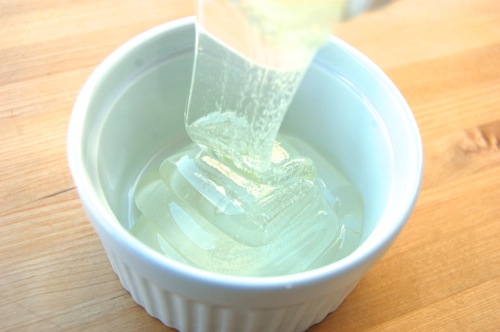
“Glucose syrup” is what some in the English-speaking world call corn syrup. Indeed this incredibly thick and sticky stuff is corn syrup, just a rather special kind. In what way? It’s exceedingly low in moisture, which makes it handy for all sorts of confectionery work where you want to keep the finished product flexible without adding extra water to it. It also has a much cleaner taste than grocery store corn syrup because it has fewer of the thickening long-chain starch molecules in it.
Rarely does a baker use glucose syrup, save in caramels and fondants. The fascinating thing about it is that despite being nearly 100% glucose it doesn’t taste very sweet compared to conventional syrups, even though it’s made of the simplest of sugars and the general rule is that the simpler the sugar, the sweeter it tastes to humans. It does of course have every bit as many calories. Even more really, since most syrups are about 20% water. Just one of the quirks of the way our taste buds work. Curious indeed.
This stuff is the bane of my existence…well, almost. In Europe it is generally made from wheat, and unsafe for celiacs, of which I am one. It is in *everything*. Sausages, candy, canned fruits, sorbet, you name it. Lots of things one would image are gluten-free, aren’t. Any thoughts on what it does for sausages? I mean, sorbet and candy I get…but meat products? Weird.
Hi Kelly!
So sorry to hear that. I had no idea that this syrup was made from wheat in Europe. Fascinating.
Regarding syrup in sausage, it does several things, some of which are aesthetic, some of which are functional. On the aesthetic side, thick syrups obviously make the meat sweeter as well as serve as a medium for colorings. On the functional side they act as a binder, helping to hold the meat together. Even more importantly however they feed the lactic acid bacteria during the fermentation process (most sausages are fermented). Sort of like adding sugar or syrup to a bread dough, it helps microbes grow. Also, once the fermentation is complete, added sugar can extend the shelf life of a sausage by actually killing bacteria. So in that sense it’s a preservative.
There are certainly more reasons, but those are the ones that I know off the top of my head. Thanks for the great question and the very interesting comment! Cheers,
– Joe
can glucose syrup be substituted or maybe even created in a home kitchen?
Hello Iztok!
It depends on the application of course. If your recipe only calls for a small amount of it, you can use corn syrup or refiner’s syrup as a substitute. As far as making it at home, it’s close to impossible since the process requires some very specific enzymes. May I ask what you’re making?Perhaps I can recommend a substitute for you. Cheers,
– Joe
Hi Joe,
Glucose syrup is so blasted sticky! Any tips on measuring and adding it to a recipe without using 2 spoons, 5 fingers, and a spatula:)
Thanks,
Linda
Try rubbing a bit of cooking oil on both the inside and outside of the measuring spoon/cup, and on your fingers if you tend to get them into what you are mixing. My grandmother taught me to do that when measuring honey.
Lynn
Thanks Lynn!
Hey Linda! I see someone answered the question for me since I was too slow this week. Thanks for the great question. Glucose is one of the hardest ingredients I’ve ever had to manage…all those long gooey strings…I guess that’s why I tend to avoid it wherever I can!
Thanks for the question!
– Joe
Just wanted to chime for anyone interested – at the restaurant where I work as a pastry cook we use glucose syrup for ice cream and sorbet along with regular sugar, helps to keep the product from getting to hard in the freezer. We use inverted sugar for marshmallows. I imagine home cooks would use corn syrup for both applications, though the amounts may have to be adjusted a bit.
Excellent, Katie. Indeed lots of people are interested. Thanks for sharing your expertise!
– Joe
I’m looking at the recipe for nougat which asks for glucose syrup or corn syrup. What can be replaced for these sticky syrup?
Honey!
– Joe
Do you have a recipe for glucose syrup?
Hi Su!
Unfortunately I don’t. It’s one of those things that can’t be done easily at home. Sorry about that.
– Joe
hi joe, i’m baking oatmeal cookies for commercial consumption my friend told me touse glucose to make it more chewy but the problem is she don’t know the exact measurements for one recipe.And it’s too sticky to scoop for it.Please help.Thank you.
Hi Alice!
I’m happy to help but can you send me the ingredients and amounts? I’ll have a better understanding of what you’re doing.
Cheers,
– Joe
I wanna make vegetarian fondant at home…neither corn syrup nor glucose syrup is available in my place…how do I make it?
using marshmallows is not happening either…
Hello Abhilasha!
You can make something similar this way: http://joepastry.com/category/baking-ingredients/syrups-ingredient-basics/make-golden-syrup/
It’s a thick syrup that works about the same way, though it will add a little color and caramel flavor. A very thick, light-colored honey might also work. You’ll have to experiment a bit, but in theory it should work!
Let me know how it goes!
– Joe
Hi Joe,
I have glucose powder in my pantry, which I’d like to use in place of glucose syrup. Is glucose syrup really >95% glucose by mass, with only a little water to hold it together? If not, what’s a good ratio for substitution?
Thanks,
Jon
Info I have found concerning glucose, celiac disease, and sucrose:
1. Glucose may be derived from wheat, but is generally considered “gluten free” as it’s wheat-protein levels are practically nil.
http://surefoodsliving.com/2008/09/is-glucose-syrup-gluten-free/
2. Glucose is less sweet than “sucrose” (fructose) or HFCS. Sucrose is 50% fructose, and HFCS is 55% fructose, with the remainders being glucose.
http://lifehacker.com/5809331/what-sugar-actually-does-to-your-brain-and-body
3. Table sugar is fructose, as it is derived from corn or sugar beets.
I hope this clears up any confusion.
Info I have found concerning glucose, celiac disease, and sucrose:
1. Glucose may be derived from wheat, but is generally considered “gluten free” as it’s wheat-protein levels are practically nil.
2. Glucose is less sweet than “sucrose” (fructose) or HFCS. Sucrose is 50% fructose, and HFCS is 55% fructose, with the remainders being glucose.
3. Table sugar is fructose, as it is derived from scorn or sugar beets.
I hope this clears up any confusion.
Hi Joe,
This is repeating a comment from above, as per your instructions on 2015-09-17.
I’d like to know how to substitute powdered glucose for glucose syrup. Are they interchangeable?
Thanks,
Jon
Hi Jon!
I’ve never worked with powdered glucose, but ounce for once (gram for gram?) it should be equivalent. A dash of water and some heat is generally all you need to turn the powder into the (very sticky) syrup.
– Joe
Good to know. Thanks, Joe.