Shredding Suet
If you enjoy mincemeat and/or British puddings, you’ve no doubt seen suet on an ingredient list. An easy-melting, mild-tasting fat taken from the kidney region of a steer, suet is akin to leaf lard on a pig. Brits of yester-year employed it as an inexpensive fat for enriching sweet baking.
It’s actually still used quite a bit, especially during the holidays, which is why you can still find commercially-shredded and packaged suet in the British Isles. Here in States the only kind of suet we can get comes straight from the steer, so we have to do the shredding ourselves.
But why shred suet? Why not just chop it? The answer is because suet isn’t pure fat. It’s suffused with tissue. Chopped into cubes, the pieces will want to hold their integrity even as they get hot. Shavings of suet incorporate into a mincemeat or pudding mixture much more readily.
Shredding is an easy thing to do. The only critical bit is the angle at which you hold your knife. A cleaver-like implement is best for this job. You want to hold it at a roughly 45-degree angle. The stroke is down-and-away from the mass of suet. It ends in a near scrape.
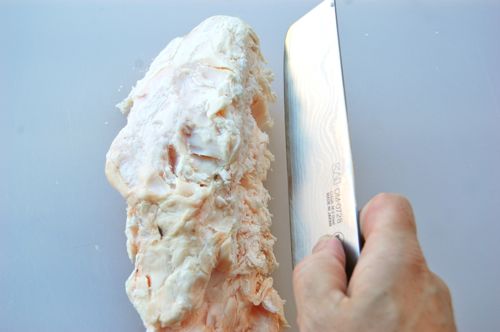
Do it two or three times and you’ll have a small pile of flakes and shreds, like so:
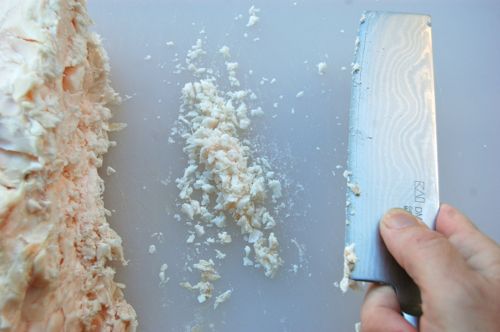
Five minutes and you’ll have a good-sized heap, as well as some slightly sore fingers. Indeed the steady rapping of the knuckles that shredding entails is the reason matrons of yore hated this job.
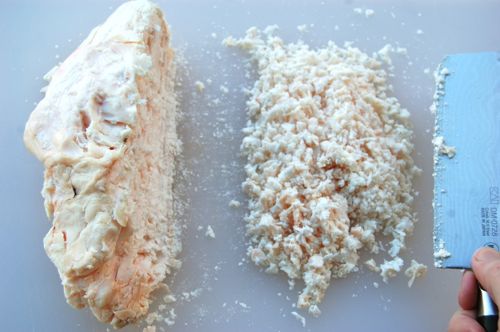
When you’ve got as much as you need — this is about half a pound — go over the pile and chop it to ensure there are no lingering chunks or strings in there.
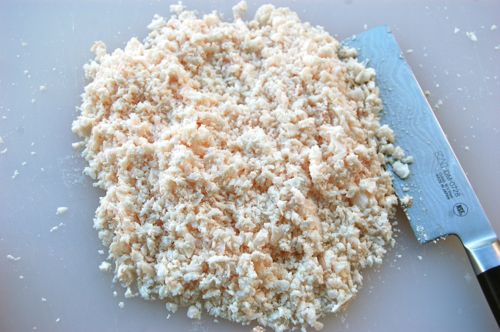
Refrigerate your shredded suet until it’s ready to use!
Hi Joe. Love suet. My memory is that for puddings, perhaps not for mincemeat, a slightly coarser shred was preferred say about 2mm across and 2-3 long. As these melted, they left the pudding light and riddled with little holes. Certainly the commercial suet was that way. I
Hey Rachel!
Great to hear from you! That’s an excellent point. When I make a pudding this winter I’ll be sure to use slightly bigger pieces!
– Joe
I vote for a British pudding series! 😀
I’ll be happy to oblige, Ann!
– Joe
Why not grate it with a micro plane grater?
I think it would clog up fairly quickly. This knife technique really is quite a bit faster also, despite the abrasions. 😉
– Joe
Arg. iPad spell changing. Microplane.
I think a British pudding series would be very interesting. I came across a mention of Sussex Pond Pudding on another blog and looked it up. It’s composed of a suet pastry that encases a whole lemon with butter and sugar added, then the pudding is either baked or boiled depending on what recipe you use. When you break into the crust, the butter, lemon and sugar are supposed to flow out to create the sauce/pond.
It sounded a bit odd to me, but then I remembered Shaker Lemon Pie which features lemon slices.
I have made Sussex Pond Pudding and it is delicious.
Have you folks seen this, a great source for British baking inspiration:
http://www.greatbritishpuddings.com/
Thanks Brian!
I am British and would also love something on some traditional warming ‘puds’ but whilst on the subject could you also cover self-saucing puddings? They’re probably a bit low rent and the only recipe i can find is very high in sugar and tastes a bit kiddie-style but I love the magical transformation of a tin full of gloop into sponge plus sauce. If there is a classy JoePastry version I would like to hear it.
I’ll see what I can do, Jane! 😉
Hi Joe,
I am making Chrismas puddings with suet that has been finely processed in a food processor.
I have boiled my puddings, 2.5 hrs in a pressure cooker for a 1 kg pudding. Once they have cooled down you can see the fat deposits through the puddings.
What can I do to stop this? It makes them look uncooked.
Hello Elisha! The problem is the processing of the suet. You want the pieces small but not so small that too much of the fat is liberated from the tissues in the suet. In that case it melts during cooking and pools. The result is those large deposits. This is why the actual shredding is so important. Get too fine and, well…you know.
Best of luck with the next batch!
– Joe
I am British and have cooked many puddings ,the best way to cook and I have many times is for Christmas pud is 6min’s in the micro wave on high, excellent every time
Many thanks, Ralph!
– Joe
I called a local grocery to see if they had suet. The butcher said he had Beef fat, yes. I asked him if it was the fat that came from around the kidneys. (I read that suet is the fat from around the kidneys) He said he did not have fat from around the kidneys and that what they had was just beef fat. Is that acceptable to use as suet? I am totally new to this and have many questions but would love to make a “Christmas Pudding”. Somewhere I read about a Christmas Pudding that you actually make and keep it a whole year until Christmas rolls around again. If anyone out there has a wonderful recipe for Christmas Pudding I would be so happy to have it. Thanks so much. Priscilla
Hi Priscilla!
It’s not the same thing and believe it or not is does make a difference. Not so much in flavor, though that’s a factor, but in texture. The muscular far won’t melt like suet will, so you’ll get a lock of chewy little pockets in the pudding instead of melty ones. Keep trying the butchers in your area. Farmers’ markets are another place to look since meat purveyors generally do their own processing.
Keep after it…and I’ll let you know if I find a recipe of the kind you mentioned.
Cheers,
– Joe
This was the first time I attempted to shred suet. I had frozen the suet (I didn’t know how long it would keep) and I wondered if it would be hard to shred. I was very pleased to discover it was quite easy to shred while still frozen. My fingers got a little cold, but it was done quite quickly, so it wasn’t too bad.
Glad to hear it, Joan. How did it perform for you?
– Joe
Any ideas on substituting fresh suet for the dehydrated suet? Modern English recipes call for the dehydrated suet but I have real suet in the freezer.
Dehydrated you say. I’ve never heard of that. Is it a sort of powder or some such thing?
– Joe