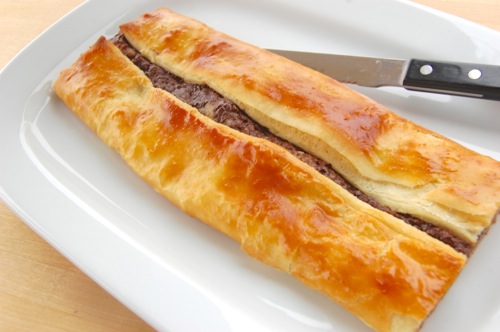
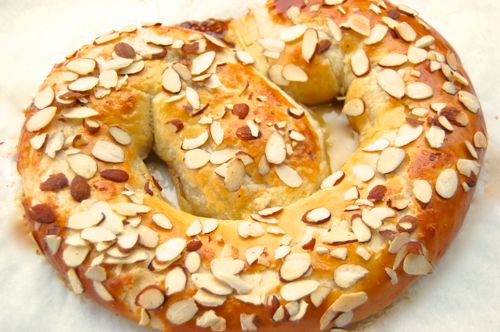
Like a lot of sort-of laminated pastries, it’s hard to put your finger on just what it is that makes kringle so delicious. It’s not a croissant. It’s not a coffee cake. You think: it’s sort of like both of them but it has it own special, oh…I don’t know what. Then the plumped raisins and hints of cardamom kick in and well…you’re hooked.
Given the payoff it’s hard to believe you can put one of these together in as little as two hours…mixing to baking. A kringle is a great way to keep up on your laminating skills, or, if you’ve never laminated before, to get your feet wet without the pressure of wasting a lot of expensive butter. You need a mere six ounces to make two of these. Start by sifting the flour into the bowl of a mixer fitted with a beater (paddle). Add the sugar, salt and yeast. Stir it all on low to combine.

Meanwhile combine the room-temperature egg and milk in a small bowl or cup and give’em a stir.

Add one to the other and stir on medium for about 30 seconds.

You’ll have the beginnings of a dough. Switch to the hook and turn the machine on medium for about five minutes.

Meanwhile make your butter pat. Make two double layers of plastic wrap. Place the butter on one of them, spoon on about two tablespoons of flour…

…then apply the other.

Next, produce your rolling pin and do violence. I like this dowel-shape Chinese pin for the job. I pity the fool who’d try to break into my house while I was laminating dough. It’d be a slaughter. Flour and slivered almonds everywhere.

Start by just tapping the butter to get a feel for it…

Then begin to hit harder as the butter starts to flatten out. I should say here that most kringle recipes call for blending the flour and butter together in a processor, spreading it out to precise dimensions, refrigerating it, warming it slightly, etc….this is more direct, dirties fewer dishes and above all mirrors the technique for croissant dough, Danish dough and puff pastry. As I mentioned, it’s excellent practice for all of those.

So where was I? Oh yes, when the butter is pretty flat, use a bench scraper or butter knife to cut it into pieces and stack it up again.

Cover it…

…and repeat the beatings. Repeat this three times and the butter should be about where you want it.

Bam, bam, bam….tap, tap, tap. You can see I broke my first piece of plastic wrap. What happens when that happens? You make another one. See here that most of the flour has been worked in at this point.

Form the pat into a rough square by pressing the edges up against the pin like so.

And there you have it.

The texture should be quite plastic. Not too soft, but malleable. It’s the flour that helps the butter keep this texture while you roll it. As I mentioned earlier this week, it’s a great insulator.

Once that’s done your dough should be ready.

Treat it with similar brutality…bam, bam bam.

And roll it out into a roughly 9″ circle.

Promptly plop the butter pat in the center.

Pull the edges around to enclose the pat…

…squeeze the edges closed and, once again, give it a little roughing up.

Hit the packet in the center, then whack outward to drive the butter to the edges. Rotate the package a quarter turn and repeat. You should be able to feel the butter out there:

So OK. Dust the work surface lightly with flour and roll the packet out to about 10″ x 20″. A bigger pin is better here as it’ll give you more leverage…if you know what I mean.

Fold in one side…

…then the other. Rest the dough in the fridge for 15 minutes, repeat the rolling folding steps, then rest the dough another 15 minutes. Or you can leave it in the fridge until you’re ready to shape and bake. It’ll keep for about 3 days.

When you’re ready to shape, dust the work surface with flour and roll it to about 12″ x 24″. Again, use your biggest pin for this job. I traded up to my big, fat, 18-incher since it makes the whole rolling process easier. Check regularly to make sure the bottom isn’t sticking to the board. If so, or if some butter is protruding out, don’t fear. Apply more flour and carry on.

Cut it lengthwise with a pizza cutter.

Fold up one of the pieces and put it away for later (this recipe makes 2).

Spread your filling (in this case it’s raisin filling) on half.

Roll the whole thing up.

Position it seam-side down…

…then roll the thing with the pin. It should be about 30 inches long when you’re done.

Shape that as you like — a pretzel is traditional, at least if you live in Denmark. Paint it with egg wash and let it proof for 30 minutes (50-60 if the dough was chilled prior to rolling.

After the proofing, paint more egg wash on it and sprinkle sliced almonds or streusel all over it. Bake it for 20-25 minutes until golden.

There will be some cracking. Cover the cracks with more almonds or drizzle on some icing!

Oh yeah, that’s it: pastry the Chicago way. And while I normally don’t advocate baker-on-dough violence of the kind I showed you today, I have to say that in this case the ends justify the means.