I spent a lot of time playing in orchestra pits as a youth. Trombone at first, then later bass. I played high school musicals mostly, and let me tell you those were some tough scores! But fun. I particularly enjoyed the overtures, when the house lights would go down, the strings would come up and the orchestra would acquaint the audience with the themes they would be hearing over the next couple of hours.
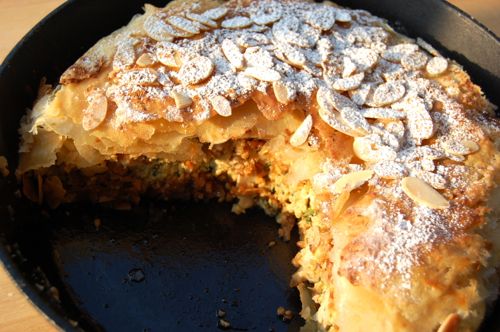
I was put in mind of those days while eating bastilla. Traditionally bastilla isn’t a main course but rather the opening of a feast. I now understand the genius of that, since bastilla has virtually every flavor and texture imaginable in it: savory, sweet, sour, spicy, hot, crisp, moist, chewy, crunchy…the list goes on. In it is a preview of every major theme that awaits the diner in a Moroccan meal. In other words, it’s a culinary overture. Begin yours by combining the butter and onions in a medium pot set over medium-high heat.

Cook until the onion is translucent, then add your spices, the cinnamon stick and chopped green (hot) pepper. Cook for a few minutes more.

Put in about two pounds of chicken parts or squab (on the bone). Or for you vegetarians out there, about a pound and a half of assorted winter root vegetables. I used a pound and a half of boneless chicken thighs since I happened to have them in the freezer. That’s as much meat as this pie can stand.

Cover with 2 cups of stock. This is some homemade brown chicken stock. It’s cold which is why it has a lumpy look…all the gelled collagen, donchaknow.

In goes the saffron…

…and the whole thing simmers for about 20-25 minutes. Note I use the word “simmer”, not “boil.” The below picture is what simmering looks like in live motion. The surface barely quivers…just the odd small bubble or two. You don’t want to boil this because boiling overcooks the meat, giving you dry chicken — even though it’s immersed in liquid. So be careful to just cook the chicken until it’s just done and no more.

When the chicken is cooked, remove it from the pot and set it on a plate to cool. Then shred it.

Meanwhile, reduce the liquid down. Remove the cinnamon stick then boil the whole mixture down to maybe a cup and a half — at most — over medium-high heat. I’ve seen bisteeya recipes that call for discarding some of this liquid. Blasphemy! You don’t want to throw even a drop of this flavor away. Concentrate it instead, you won’t be sorry.

Now then, with the sauce reduced, drop the heat to medium and add the parsley and cilantro.

Let that cook a couple of minutes, then add in the eggs.

Stir that around until the eggs scramble and almost all the liquid is absorbed.

Then add back the chicken. One of your two mixtures is now ready. Set that aside while you prepare the almond-sugar mixture.

Toast the whole or slivered almonds in a 400 oven for about ten minutes. Get a nice tan on them.

Combine them with the sugar and the cinnamon in a food processor…

…and grind to a crumbly texture. There, that’s done. Time to assemble! Turn the oven down to 375.

Secure a 9″ cast iron skillet or cake pan. Lay in several sheets of warqa pastry or phyllo in an overlapping pattern and brush them with butter. Give yourself plenty of overhang. Put another sheet right in the center there, lining the bottom (not shown). (Some assembly required).

Lay in about half the almond mixture.

Then the chicken & egg mixture.

Top that with the rest of the almond mixture…

…then fold in the dough sheets over the top. Brush some butter on the top…

…then place three or four more sheets of dough on the top, buttering each as you go, and tuck the edges down around the sides.

More butter!

Put that in your oven — a brick oven is fun to use for this, say, if you’ve baked bread earlier in the day and it’s been cooling down. The nice thing about bastilla is that you don’t really have to worry about doneness all that much. The ingredients are all pre-cooked. All that really needs to happen is for the pastry to brown.

To finish the pastry, sprinkle on some toasted slivered almonds. Dust those with cinnamon..

…then powdered sugar. Alternately you can leave off the almonds, apply the powdered sugar, then lay down stripes of cinnamon in a criss-crossing pattern. Many Moroccan bastillas are finished this way.

Done! Serve this slightly warm or at room temperature. You can transfer the bastilla to a serving dish or go the rustic route and serve it straight from the pan. It doesn’t slice terribly well, but then in Morocco you’d just scoop some up and eat it by hand in the Arab style. The manner in which it makes it to your mouth isn’t very important, so long as it gets there.