Category Archives: Pastry

Pass the Funyuns, Kemosabe

Reader Sal (love that name) wants to know what sort of camping I’m talking about here. Backpacking? Car camping? RV camping? That’s a fair question, Sal, as the equipment kit and larder capacity is different for each of them. I’m going to pick the middle road and say car camping, since that’s what Boy Scouts and Girls Scouts do, and it’s what I do with the family when I simply can’t resist their pleas any longer. We’ll assume everyone will have access to cooking gear and will have a cooler of the usual store-bought foods with them.

On which note I feel I have to ask why most camping trips are also junk food pig-outs? I’m not complaining mind you, I like it for the most part, but I’m always amazed at the degree to which the nature-loving indulge in the sort of eating they decry under normal circumstances. I know Mrs. Pastry does. She won’t touch, say, a box of Bisquick unless it’s under a starry sky by a camp fire. Clearly the reason is because foods that are full of preservatives (and I include very salty and/or sugary foods in that category) last longer and are generally safer when kept in a cooler for several days. I just make fun is all.

Here I’ll insert that I’m going to go the open fire route with the pastry this week at least. I’m going to have the brick oven going this Thursday and a Dutch oven won’t work in it. It’ll still leave me plenty to do!

Filed under:  Pastry | 2 Comments

The Existing Camper’s Inventory

Before I start logging new ’round-the-campfire pastries I thought a good first step would be to inventory the camping-friendly recipes that are already on the blog. Indeed there are quite a few, especially if you count the make-ahead cookies and cakes. However I realize that part of the fun of campfire cuisine is actually assembling and cooking the whatever-it-is on the fire.

S’mores are of course an American classic. Strawberry shortcake is another time-tested campfire delicacy, and it can be easily made with packaged biscuits in a Dutch or cardboard box oven.

Chimney cake has been popular with campers the last couple of years. I’ve gotten excellent reports from the field. For those who are up for deep frying at the camp site, fritters are easy, delicious, and they give you the pride of having made an indulgent dessert from scratch in camp.

That’s everything that I can see that makes a natural transition to the bonfire. If anyone else has ideas about Joe recipes that can be adapted to the field, tell me!

Filed under:  Pastry | 10 Comments

Why is Iodine Important?

Reader Zoe writes:

I’ve been interested to read some of the comments on the subject of iodine and salt. I’ve always noticed that salt is “iodized” but have wondered why that’s important. Can you go into the subject a little? I’d be interested to read more.

Zoe, you never have to prod me too much to delve into a topic like this. Since we’ve been flirting with various subjects related to diet and health this past week, it only makes sense. Commercially made table salt is iodized by law in the US. It’s natural to wonder why.

Iodine is an element that’s essential to human health. It’s used by the thyroid gland to manufacture two very important hormones by the names of thyroxine and triiodothyronine. Together these hormones help regulate our metabolism. The thyroid gland in the neck is the organ responsible for trapping the miniscule amount of iodine that the human body needs. As long as iodine intake remains more or less constant, the thyroid hums along, quietly doing its job.

The trouble starts when the amount of iodine we take in decreases. In response the cells in the thyroid gland increase in size in an attempt to capture more of what they need. Critically low levels of iodine in the diet thus lead to a dramatic swelling of the thyroid gland. This neck swelling is the condition known as “goiter”. And while it’s mostly just unsightly, the condition also causes profound fatigue, coldness in the body and in extreme cases brain damage.

The main source of iodine on planet Earth is the sea. Thus, eating a steady diet of salt water fish is all it really takes to give your body the iodine it needs. Remarkably the body needs so little iodine to function it’s possible — provided you live right near the ocean — to breathe in enough iodine to sustain your metabolism.

Of course most people don’t live right near an ocean, and as a result are at risk for goiter. In the United States prior to the discovery of the link between iodine and goiter, there was a so-called “goiter belt” that extended from the Pacific Northwest all through the Great Lakes. In the early 20th century, up to 40 percent of the people who lived in that region suffered from goiter in some form. Thus is was a great relief when state and federal governments teamed up with salt companies in 1924 to deliver iodine to the American people via table salt. It was the world’s first “functional food.”

The fact that so many people these days — notably foodies — are opting for non-iodized specialty salts is a bit alarming. For people who are aware that fleur-de-sel and other high-end salts lack iodine, and can remember to take regular iodine supplements, it’s not an issue. However most of us alive today don’t remember iodine-related health issues like goiter and so don’t appreciate the boon that is iodization.

The bright note here is that commercial food packagers use standard iodized salt in their products. That being the case, if foodies can remember to eat a fair amount of cheese or the odd bag of Doritos, they’ll probably get all the iodine they need.

Filed under:  Pastry | 4 Comments

This week is camping week.

I’ll admit I’m not a big fan of camping. Oh I like the outdoors plenty, I just have bad associations with tents and sleeping bags. Being the nerd in my scout troop I was always the kid whose backpack got filled with rocks, or who climbed into his sleeping bag only to find someone had put a hundred of those little restaurant butter pats inside. Hey, you try sleeping in 40-degree weather when you’re greased from head to toe, OK?

However very recently my eyes were opened to the potential of camp fire cuisine. Over the weekend Mrs. Pastry completed her training to be a Girl Scout troop leader, and her reports from the field were nothing short of astonishing. There are some truly inspired camp fire baking techniques out there. Most of them require lots of mixes, plastic bags and whatnot, but who cares? The science is sound. Maybe some of you trail-hardened outdoors people out there can weigh in with tips or suggestions?

Filed under:  Pastry | 26 Comments

On-the-Edge Q & A

Reader Silviu writes:

Reading [your posts on Michael Pollan] leaves me wondering what’s your approach to ingredients and food in general? Do you fit in any particular category (organic, local, etc.)? Do you have some never-touch-that rules? What do you think of sugar and pastry (I mean pastry is mostly not pastry without sugar)? I’d love to read a whole post on this.

Silviu, I try not to touch hot-button questions like this since they often lead to go-nowhere comment field combat, a lot like the trench warfare at Ypres. In the end, after all the shells and noxious gasses have been released, little has been accomplished and nothing has changed. But since you asked I’ll go for it. Briefly.

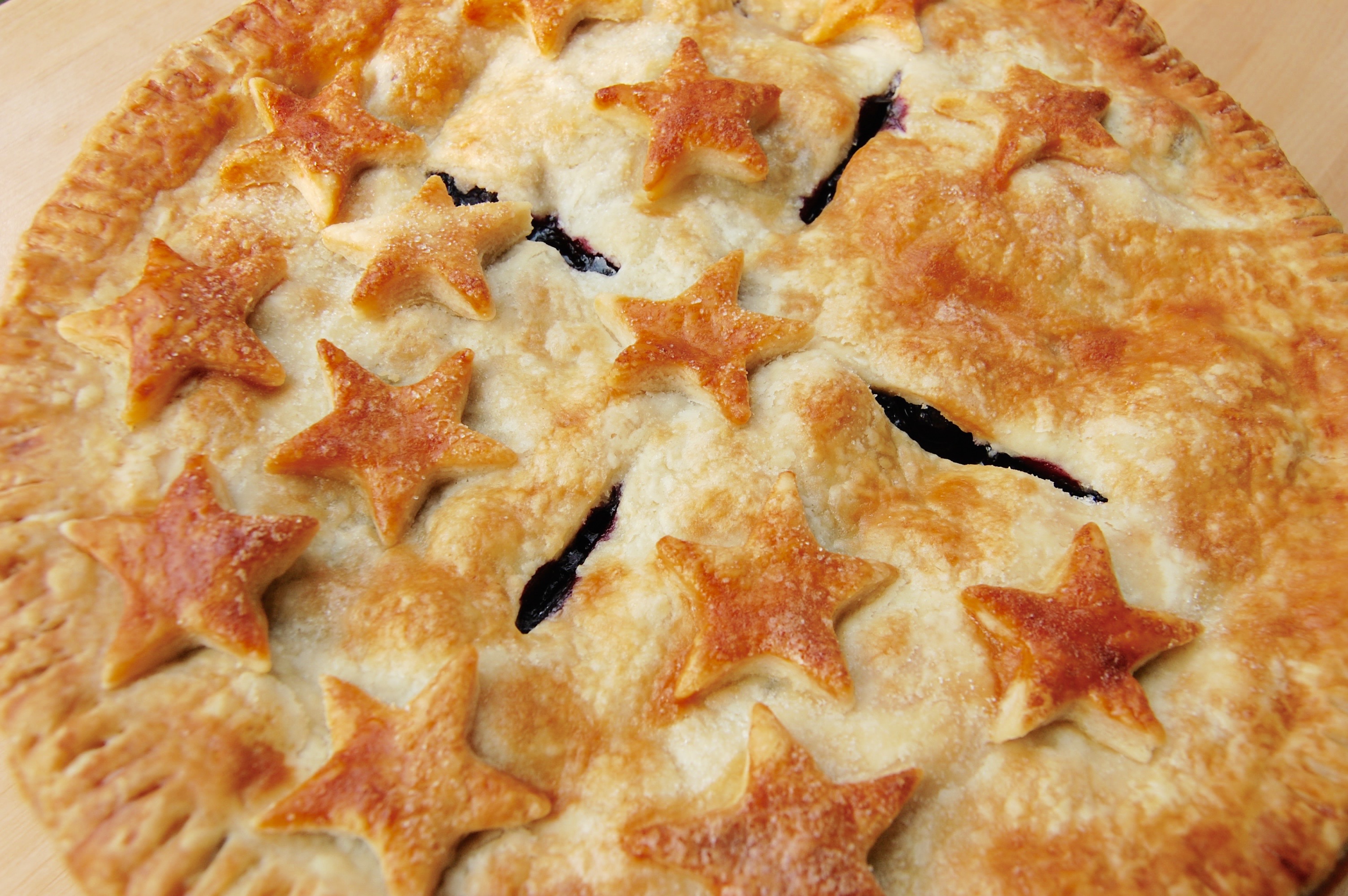
My core belief is that pastry is no place for killjoys. Diving into a warm piece of blueberry pie with ice cream on top I don’t want anyone asking me if the berries are organic or the cream is pasture-raised. It’s simply not the place for it. Pastry is supposed to be fun and delicious. Politics only give it a medicine-y aftertaste.

I used to quip that the pastry maker is the natural enemy of the oragno-nut, but it kept getting me into trouble so I stopped. What I meant by that was not that I was hostile to anything organic, but that if you’re going to make pastries you’re by definition acting against local/organic orthodoxy. Most of the foundational ingredients of pastry are either highly refined or come from a long way away: sugar, flour, chocolate, flavors, colors, you name it.

Is it possible to make good pastry that’s local and organic? No question that it is. Alice Waters is a good example of someone who makes excellent local, organic sweets. However, and maybe it’s just me, I can never eat one of her desserts without thinking: gosh, this is really good for something that doesn’t have anything delicious in it! I find myself making a mental note that if society ever ends and we descend into a Mad Max-like dog-eat-dog dystopia, I’ll know whose book to use when I get a craving for cobbler.

Do I care about local and/or organic foods in general? I care if they’ll make my spinach tart taste better — and not break the bank in the process. But when it comes to food I’m simply a consumer. I don’t feel the least guilty about that, for if local/organic foods are ever going to succeed on a macro level they’re going to have win not only in the realm of activism, but in the realm of quality, price and convenience. I try harder than most people to secure quality ingredients for the things I make. If the local/organic crowd can’t make it worth my while to drop by their tent in the church parking lot on Saturday morning, I can’t be held responsible. I’ve got a kid that needs to get to soccer practice.

As for never-touch-that rules, I definitely do have some. I once touched the intake manifold of a ’72 AMC Javelin with my ear while helping a high school buddy do a car repair, and brother, you think you know pain. Another time I mistakenly tried to pat the head of an extremely grumpy cat. As far as food rules are concerned, I only have one: eat a variety. All things in moderation is not only time-tested wisdom, it’s being increasingly validated by science. I don’t eat gâteau Basque three meals a day and I don’t recommend that anyone else do it. But it sure is a nice surprise after a light dinner on a Thursday night.

I started this blog because I had a simple aim: to give people the skills to make basic — and maybe some not-so-basic — pastry at home. If people want to apply those skills to making organic pastry, I say great. I’ll help them trouble-shoot their cruelty-free vegan marjolaine if they want, and I’ll be pleased and proud to try a piece when they’re finished with it. I’ll happily do the same with a trifle made of box cakes and pudding mixes. In both instances I might make some wisenheimer side comments about using a pastry cream that has actual eggs in it, then probably go for a second piece.

I get happy whenever anyone tries making a pastry at home. I encourage it because think it’s fun, I think it tastes good and I think it’s healthy. And that’s about all I can some up with on the subject.

OH AND…I will be approving comments on this post, but not moderating them after this afternoon because life is only so long.

Filed under:  Pastry | 20 Comments

Making Gold Cake

What do you do after you’ve made angel food cake and you have a dozen yolks left? Make gold cake of course. My grandmother always did and it looked pretty much exactly like this, colonnade frosting and all. You make this cake in very much the same fashion you do angel food cake, save for the fact you need baking powder to help raise it. Start by getting your ingredients together, preheating your oven to 350 degrees Fahrenheit, and preparing your pan.

Cut a piece of parchment to fit the bottom of the pan:

Then apply a little cooking spray or butter to the pan.

Combine the flour, salt and baking powder in a medium bowl.

Next, put the yolks in the bowl of the mixture fitted with the whip.

Whip for about a minute on high until they’re lemon yellow, then add the milk.

Whip that mixture into a foam that’s about as thick as heavy cream. When you pick up the whip you should see some light tracks on the surface. You can whip this higher, but you don’t want to, trust me.

With the machine running, add the sugar in a steady stream. Just pretend that whip is whipping, OK? We’re dealing with low production values here.

Whip for about another 30 seconds until the sugar is dissolved. The mixture should still be thick, but drip readily off the whip.

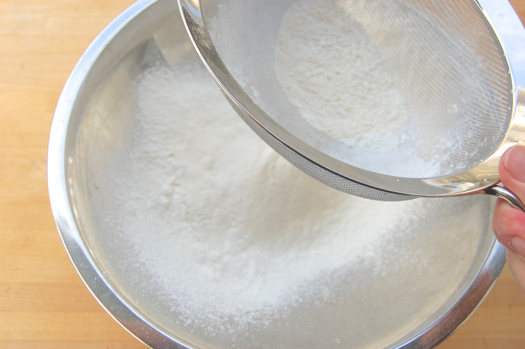
Now sift about a third of the flour mixture onto the egg mixture.

Fold that in.

Sift on another third, fold, and sift on the last of the flour.

Fold the batter until it looks about like so. A few streaks or spots of flour are OK.

Pour and/or scrape the batter into the prepared pan and put it into the oven.

Bake about 40 minutes until about this color. Gold or something.

Let it cool about ten minutes, then run a butter knife or icing spatula around the rim and the tube to loosen it.

Flip the pan over and de-pan the cake, the peel off the parchment.

Let it cool all the way down before you ice it. It goes well with just about any icing or frosting you care to apply.

Filed under:  Gold Cake, Pastry | 4 Comments

A Little Housekeeping

Is anyone out there having trouble posting a comment? Also, has the Odwalla ad finally disappeared? I complained to my ad network about it and they said they’d take it off…but…you know.

Filed under:  Pastry | 14 Comments

Making Colonnade Frosting

The amazing thing about this frosting is that while it looks like a standard seven-minute frosting it behaves much, much differently. Whereas seven-minute frosting hardens to a stiff meringue-like consistency almost immediately after it’s made and applied, this stays smooth and spreadable — even after several days in the refrigerator. That makes it somewhat dangerous since leftover frosting is wicked good on a vanilla wafer, or two, or three…

On a cake colonnade frosting sets up after about twenty minutes, and while it may form a thin crust, underneath it remains soft. As for why this frosting is named for a row of columns in a classical Greek structure, I can’t say. Start by assembling your ingredients. Combine the sugar, corn (or glucose) syrup in a small saucepan and bring it up to 238 degrees Fahrenheit (soft ball stage).

Meanwhile, put the whites in the bowl of a mixer fitted with the whip.

Whip to stiff peaks. I nearly overdid it here. These are maybe a little too stiff for comfort…they’re nearly dry, and dry is not what you want.

When the syrup is up to temperature quickly transfer it to a glass measure or some other convenient pouring device. With the machine off, pour about an ounce of the syrup in. Turn the machine on high for ten seconds. Turn it off, add another ounce of syrup, turn it to high for 10 seconds, you get the idea. The frosting will increase in volume and silkiness.

Lastly whip in the powdered sugar (and any colorings or flavoring you’d like). The powdered sugar adds body and, I believe, the small amount of corn starch works as a dessicant to keep the frosting from weeping.

Use right away or store in the refrigerator for later.

Filed under:  Colonnade Frosting, Pastry | 2 Comments

Well dang…

My gold cake fell. Why did this happen? Because I over-whipped my egg yolk foam. Though you wouldn’t think it, egg yolks and liquid can be whipped to a very high foam — at least temporarily. And you don’t need any special liquid to do it, water will work. It’s all those emulsifiers in egg yolks, donchaknow…they create a thick lipid-water mixture that (at least temporarily) reinforces air bubble walls.

I got so geeked out on that yolk foam that I let the whipping go on too long — especially after I added the sugar. Which meant I had too many air bubbles in the batter. Then when the cake hit the oven the baking powder went off and pushed the cake still higher. That created an extremely weak interior structure that couldn’t hold long enough for the batter to set and…this is the result. Oh well, I needed more egg whites anyway…

Filed under:  Pastry | 2 Comments

Can sugar really “cook” egg yolks?

Reader Lily writes:

Joe, the other day I left some egg yolks that I was about to whip into pastry cream sitting in a bowl with some sugar for too long. The yolk sides that were touching the sugar turned pale and hard. My instructor said that it was caused by sugar cooking the eggs because sugar and yolks together create heat. I’m skeptical, but what do you think?

Ooh! I love this question! Lily, it’s common kitchen lore that egg yolks and sugar react to create heat. You’re right to be skeptical of that claim, though it certainly can appear that a yolk that’s in contact with sugar has been cooked (especially if the yolks are a nice, deep yellow). In the picture above I left an egg sitting on some sugar for about twenty minutes. You can see that there’s a ring of lighter colored yolk along the bottom where the two are touching. What’s causing that?

Sugar, as I’ve discussed on many occasions before, is a hygroscopic substance. Which is to say, it absorbs water. It absorbs it from the air, but it’ll also absorb it from an egg yolk if the two are in contact, right through the yolk’s membrane (that there’s called osmosis in science-speak). An egg yolk contains a mixture of water, fat and protein with a few sugars and other miscellaneous nutrients mixed in. Take the water away and the long stringy protein molecules get closer to one another, eventually to the point that they coagulate into clumps. So that’s what you’re seeing there: concentrated egg protein.

I’ll add that once egg proteins clump up like this there there’s no reversing the process. My best advice is to keep your eggs and sugar separated until you’re ready to whip!

Filed under:  Pastry | 13 Comments