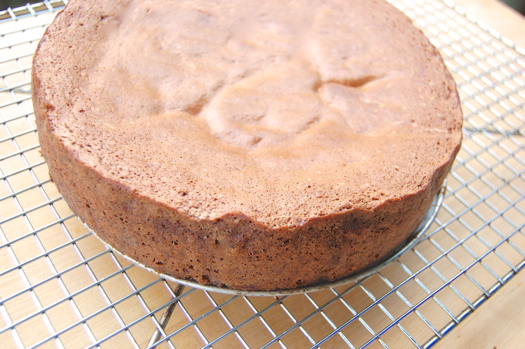
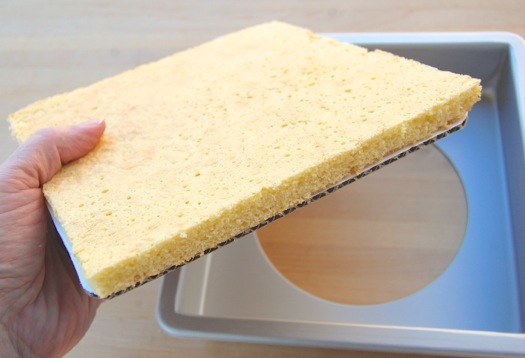
Even the best pastry makers occasionally fail at making génoise. The reason, because it can be tricky to know how much to beat (or whip) the eggs and sugar. Too little and you get an unspectacular rise. Too much and you get no rise at all.
Huh? How does that work? Well you see, an egg-and-sugar mixture can be whipped up to an unbelievable degree. Five or six times if you really put the spurs to your mixer. That creates very big bubbles, which when heated, pop. The result is a flat disk of egg and sugar. So be aware and only whip your eggs to about triple their volume. You’ll be amazed at the degree to which the batter will rise.
To make a good génoise, have all your ingredients and implements ready ahead of time. That will allow your to move from one step to the next promptly (especially after the foam has been created).
The first step is to have your oven preheated to 350 and your baking pan — be it flat and shallow or round and deep — prepared and waiting. Once that’s done, you’ll want to finding a saucepan that will comfortably fit your mixer bowl, like so:

Take the bowl off the saucepan, put about an inch of water in it, and set it to simmer. Now then…sift your flour and salt into a medium bowl.

Off the stove top, add your sugar and eggs to the mixer bowl…

…and give them a good whisking.

Put the bowl over the simmering water and continue to whisk until the sugar is dissolved that the mixture is warm to the touch (no more than 120 degrees F).

Take the bowl off the simmering water and attach it to the mixer, onto which the paddle has been affixed. Beat on medium-high for roughly 8 minutes, until the mixture is extremely foamy. This is actually too thick. See that fat ribbon? You don’t want that. Look how big those bubbles are that are rising there. Too big. But there’s something you can do if you over-beat…I’ll tell you about it later. For now, just make sure to beat in the vanilla.

For now, take about a cup of the foam and stir it into your melted (ideally clarified) butter. This will help the butter to more readily incorporate into the main volume of the batter.

Stir until it looks about like so (no need to be gentle):

And gently pour the mixture back into the mixer bowl…

…sprinkle in the flour and salt…

…and using your largest rubber scraper or spatula, fold until the mixture is uniform (instructions on how to fold properly are under the Techniques” menu to the right). This bumpy look is a sign of an over-beaten batter. It should be smooth on top…but there you are.

To counteract the effect of a batter that’s got too much air in it, knock the form on the kitchen counter a few times to break the very large bubbles. It should bake up normally after that.
As for the form, this batter will fill either a 13″ x 18″ sheet pan or a 9″ x 2″ cake layer pan.