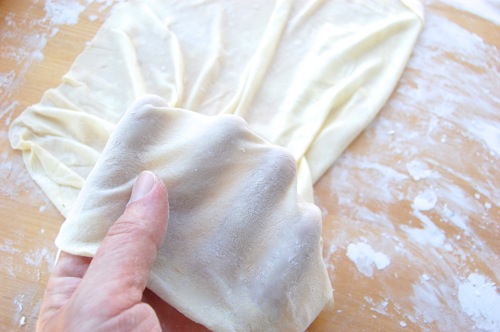
Thin as this dough is, it’s about three times as thick as the store-bought stuff. But you know we’ve all been down the pre-made filo dough road before. We know where it leads: a quite good, if very expected, texture and taste. Make filo yourself and you won’t have the extreme flakiness, but you’ll still have plenty, plus a little extra crunch, chew and depth of flavor. I recommend the experience highly. The dough is stretchy and forgiving, really fun to work with. Just prepare yourself for a few failures at first. You’ll still get enough sheets out of a regular batch to build a very nice pastry.
I want to reiterate what an revelation a ultra-thin rolling pin is. Six bucks will get you a 1″ dowel rod at any hardware store. It’s a little hard on the knuckles, but it gives you control like you’ve never had over thin sheets of dough. It also lets you apply focused, extreme pressure to dough edges, something you never get with a standard fat pin. I won’t use it every day of course, but it’s definitely staying within reach in the kitchen. Start your dough by sifting your flour and salt into the bowl of a mixer.

Add your water and olive oil.

Stir it on low with the paddle until a dough forms.

Switch to a dough hook and knead about six minutes on medium-high (you want to hear plenty of slapping) until the dough is nice and smooth. Wrap that puppy in plastic and let it sit on the counter for an hour or so.

When you’re ready to roll, remove a roughly 2-ounce piece of dough to a work surface that’s well-dusted with corn starch (cornflour). Apply your skinny pin(ny).

The dough will roll easily to this size. Dust it again liberally with the starch, turn it over and dust again.

Roll it out to about this size. Don’t rush. Turn it this way and that if need be, flip it and always have more starch at the ready. Press harder at the very edges where the sheet will be thickest. Wow, that was really easy, actually. Yes you’ll get some creases and maybe some small tears. Don’t sweat ‘em, you’re doing something special here.

Once the dough is about 9″ x 11″ or so you’ll find you can stretch it by hand the rest of the way. Pull it, hold it for ten seconds or so, then set it down. Tug on the corners until you have a rough 10″ x 12″ rectangle. Let it sit about another ten to twenty seconds so the gluten gets used to the idea of being this thinly stretched.

Remove the sheet to your wax paper or parchment stack. You can use your open palms to do more stretching if you like. Lay on another sheet of paper and repeat the process.

Some sheets will be uglier than others. Some will have tears. Don’t worry about it. Use your best sheet for the top and no one will ever know that those below aren’t perfect. Opa!