Category Archives: Spread-On/Pipe-In Fillings

Making Stabilized Whipped Cream

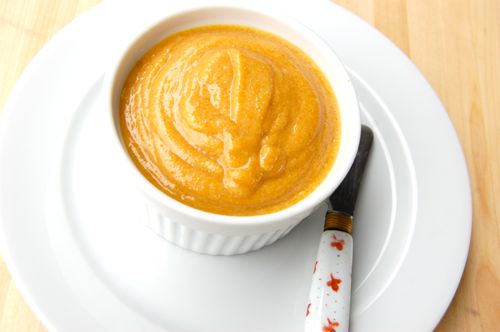
Sure, there are plenty of purists out there who don’t believe cream should be adulterated with stabilizers. I’m with them…some of the time. The rest of the time I’m worried about my whipped cream holding up for long periods, on warm days or in the freezer. Then I’m looking for a little somethin’-somethin’ to help me get by.

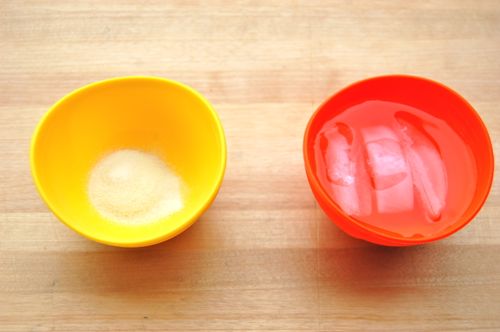
That something is gelatin. Just a little will do wonders for your whipped cream’s stability, and honestly, it barely impacts the taste or texture. Start be melting a little gelatin. For 2 cups of cream you’ll start with a 1/2 teaspoon of powdered gelatin and a little ice water. Yes, these are my little silicone Trudeau bowls again. I love them, that’s why I plug them. They’re wonderful:

Pour about two tablespoons of the ice water into the gelatin and let it sit for five minutes (no stirring).

What you’re doing here is creating a little protein gel. See?

To use it you need to melt it. Zap your little silicone Trudeau bowl — if you have one — in the microwave. Use short full-power bursts of 5 seconds. That should be all you need to liquify it.

With that in hand, whip 2 cups cream.

Partially. Get it part-way thickened, then add your sugar…about 1/4 cup for this much cream.

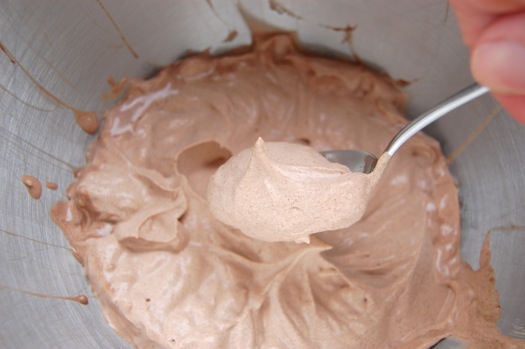
Whip it for another ten seconds, than add any flavoring you want. Here I’m putting in about 3 tablespoons of espresso syrup.

Whip another ten seconds (you’ll probably be getting close to soft peaks by now) and pour in the melted gelatin.

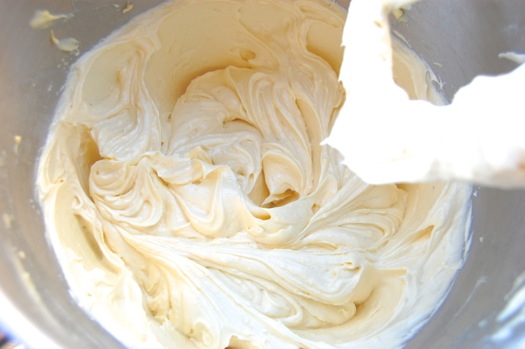
Whip the cream the rest of the way, somewhere between soft and stiff peaks, according to your liking.

You’ll need to use this within about half an hour, which is when the gelatin will start setting up, making smooth spreading more difficult. Consume any leftovers on scones.

Filed under:  Pastry, Stabilized Whipped Cream, Stabilized Whipped Cream | 10 Comments

Making Chiboust

Call it chi-BOOST, call it she-BOO, it’s a sweet, light and delicate filling either way. Pastry cream lightened with Italian meringue is what it is, and it works well in just about any context where you want a large volume of filling, but don’t want to overwhelm the eater with richness or heaviness. A Paris-Brest is a good example, or a Gâteau St. Honoré. Bear in mind that chiboust — like most meringues — doesn’t like humidity. And while it can be piped, pipe it only through large-bore nozzles, since constriction and pressure causes it to deflate and go runny. Here I have about a cup of the firmer of the two pastry creams that are up on the site.

To that I’ll add a roughly equal amount of Italian meringue

…and fold it in. Then another equal quantity of meringue…

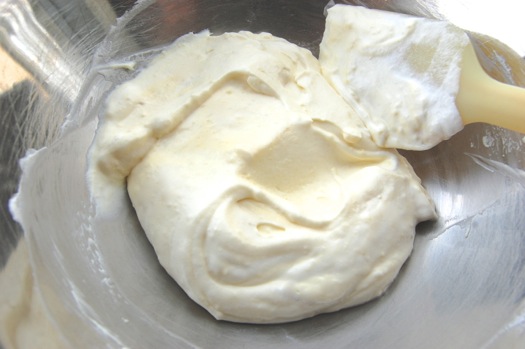
…and finally another until I’ve got something that looks about like this.

And ze she-boo, she iz done!

Filed under:  Chiboust, Pastry | Leave a comment

Lenôtre Pastry Cream

Just because a component fails in one application doesn’t mean it isn’t good for another. This preparation is too thin and creamy for use in a layered pastry, but would be excellent as a filling for éclairs, in Paris-Brest or in any number of other applications where its eggy silkiness would be an asset. It’s made from whole milk, so it’s a bit lighter than a standard pastry cream (often made with half heavy cream), and even though it has the same amount of sugar it doesn’t taste as sweet. To make it you’ll need:

the seeds of 1 vanilla bean
32 ounces (1 quart) whole milk
8 ounces sugar (1 cup plus one tablespoon)
12 egg yolks
2 ounces (1/4 cup) cornstarch

Start by combining the seeds of the vanilla bean with the milk in a medium saucepan and bring it to the boil.

Give it a good whisk every so often.

Meanwhile, combine the yolks and sugar in the bowl of a mixer fitted with the whip.

Whip on high for about three minutes until a thick ribbon drips off the whip.

With the mixer running on medium-low, add the cornstarch in a steady stream. Scrape the bowl to make sure it’s all incorporated.

Now add the hot milk in a steady stream.

When it’s completely incorporated, pour the whole works back into the saucepan…

…and whisking steadily, bring the mixture up to boiling. Let it bubble — not violently — for about 45 seconds to a minute.

Pour it into a bowl, and allow it to cool for about ten minutes. Don’t worry about the foam, it’ll subside eventually.

Lay on some plastic wrap to prevent a skin from forming. About half a tablespoon of melted butter will accomplish the same thing.

If you make the full recipe, you’ll want to cool the bowl in an ice bath, then put it in the refrigerator. A half recipe will cool down enough in half an hour to be placed in the fridge on its own.

This is kind of a neat method, isn’t it? The all-in-the-mixer “whipped egg” technique creates a lighter and more elegant product than the standard whisk method, plus you don’t get any thick curds…eet iz very nice. But not for Napoleons.

Filed under:  Pastry, Pastry Cream, Pastry Cream | 4 Comments

Making Praline Paste

Perfectly smooth, commercially-made praline paste is ubiquitous in many parts of Europe. Here in the States it’s virtually unknown. However once you taste it I have no doubt it will quickly attain a place of prominence in your spread pantheon — alongside nutella, peanut butter, jam and, for you Aussies and Brits, vegemite and marmite. It’s also very handy as a pastry ingredient, obviously. Begin with the praline. Lay the nuts out on a lightly oiled sheet of parchment paper.

Then make the caramel. Combine the sugar and the water in a pan…

…and swirl over high heat until it’s the darkness you prefer. I wait until I see wisp of smoke or two since I like mine with a slightly more pronounced flavor. Most people prefer theirs a slightly lighter amber.

Anyhow…pour the caramel over the nuts and allow the caramel to cool completely.

When cool, break up the praline and put the pieces in your food processor (you can also first break down the praline by putting it in a plastic bag and hitting it with a mallet, that will save some wear and tear on your food processor blades if you decide you want to do this a lot — thanks to reader Ed for the tip!).

Start processing the praline. After about 30 seconds or so you may start to wonder if you’ve done something wrong, since it pretty much stays a bunch of crumbs.

However after another 30 seconds or so you’ll start to see that the oil is leaking out of the chopped nuts and beginning to create a more butter-like mixture.

Another 30 seconds or so and you should have something that resembles home-made peanut butter. If not, if you’re having a hard time breaking down the praline, you can prime the pump with a tablespoon or two of oil. A nut oil is ideal (walnut oil, say), though a less expensive oil like peanut will work very well too. Failing that, a neutral vegetable oil will work just fine.

To reduce the particle size still further you can take this paste for a spin in your blender. That’s what I did to get my final, barely grainy consistency. But you may decide after tasting it that you don’t need to take things to that degree. It tastes amazing either way. Oh, and did I mention that for a subtle, slightly salty taste that sets the caramel off even more, you might want to add a quarter teaspoon or more of salt? I didn’t, no. Shame on me.

Filed under:  Pastry, Pastry Components, Praline Paste, Praline Paste | 22 Comments

Praline Paste Recipe

People tasting praline paste for the first time tend to fall to their knees and weep for all the wasted years. For while it is an ingredient, it’s also a spread in its own right, a sweet nut butter with strong caramel overtones. You’ll need to resist the urge to keep spooning it into your mouth until it’s gone. The formula is elementary: 1-1 sugar to nuts by weight, but most people like to divide the proportion of nuts between blanched almonds and hazelnuts. So let’s say, for purposes of argument, you wanted to make a pound of praline paste for a mid-day snack. You’d use:

8 ounces granulated sugar
1/4 cup water
4 ounces blanched almonds
4 ounces hazelnuts (peeled makes the best presentation)

Place the nuts on a sheet of lightly greased parchment paper or a silpat. Then simply add the water to the sugar in a small saucepan and heat it over high heat, swirling until the mixture turns to caramel. Dark amber is usually the degree most pastry makers cook to, though you can go darker for a stronger flavor. Pour the caramel over the nuts and allow the mixture to cool completely. Then break the praline into pieces and grind them as finely as you can in a food processor until a paste forms. It won’t be as smooth as commercially-made praline paste, but the flavor will be, well…you’ve got to try this stuff to believe it. If you want to absolutely go nuts, add in:

2 ounces melted dark chocolate

…during the final blending step.

Filed under:  Pastry Components, Praline Paste, Praline Paste | 7 Comments

Making Bavarian Cream

Oh silky, lovely bavarian cream…all set to be poured into a mold (after I’ve dipped my finger in it a time or two, of course). Making a crème anglaise-style Bavarian cream is only a little more complicated than making crème anglaise. All you’re doing is combining your custard with whipped cream and gelatin. Easy. Below I’m attempting to make it outdoors in mid-afternoon on the hottest day of the year so far, which is less easy. Why bring that up? Because I wanted you to know how much I toil and suffer for you. Feel guilty? Good, then let’s move on. Prepare an ice bath in the largest bowl you have.

Now add the gelatin to the small quantity ice water (swiped from your water bath, of course).

Now add your egg yolks to your sugar in a large bowl…

…and whisk until well-combined.

Combine the half-and-half with the vanilla seeds in a small saucepan, whisk and bring to the boil over medium-high heat.

Slowly pour the boiling half-and-half into the egg mixture, whisking all the while. No, I know I’m not whisking, I’m taking pictures! Gimme a break!

Pour the mixture back into the saucepan…

…and heat the mixture to thicken the yolks. Your target temperature is 196 degrees. Much more than that and the eggs will start to cook into lumps. A lot of very experienced pastry chefs don’t use a thermometer during this stage of the procedure, preferring to wait until they see the first bubble, indicating that the custard is about to boil. Then they remove the custard from the heat. They get lumps, but then the mixture is strained anyway. It’s really up to you what you’d like to do here.

When the crème anglaise is up to temperature, strain it into a clean bowl.

Now dump in your blob of gelatin — plunk!

…and whisk it in. It will melt very quickly.

Now’s a good time to add any flavorings that might complement your preparation. Here I’m adding a little Amaretto, maybe two tablespoons.

After everything is whisked together, place the bowl into the ice water bath. This not only cools the mixture, it helps the gelatin to start setting up.

While the custard is cooling down, turn your attention to the whipped cream. Add the cold heavy cream to the bowl of a mixer fitted with a whip…

…and whip to soft peaks.

Now return to the custard. It should be only slightly warm by now. Stir it gently with your spatula, scraping any congealed custard away from the sides of the bowl. It will re-melt as you stir. Continue to do this as the mixture cools down. The texture you want is a bit hard to describe. You want it thickened slightly, but not so thick that the gelatin makes lumps in the finished product.

You can sort of see what I mean. Look at the edge of the pool of custard where it meets the pan. As I’m stirring and scraping, it’s bulging a little.

And when I pick up the implement up out of the custard I’m seeing very faint tracks. This texture is almost like a yogurt drink, like kefir. Make sense?

Now that your custard has started to thicken, remove it from the ice water bath and start folding in the whipped cream…

…until it’s all incorporated. (For more on folding, see the tutorial under the Techniques menu).

Done! Now promptly pour the finished Bavarian cream into whatever mold you intend, because the gelatin will set up in earnest before too much longer.

So there you have it. I confess it’s a touch involved, but trust me, good Bavarian cream is one of life’s great simple pleasures. You will enjoy it.

Filed under:  Bavarian Cream, Bavarian Cream, Pastry Components | Leave a comment

Bavarian Cream Recipe

I hesitated at first to do Bavarian cream because I’ve had so many bad experiences with it. No, not making it. Eating it. For Bavarian cream is a much abused substance in the baking world. So often it has so much gelatin in it that it comes off like JELL-O pudding. Thankfully, pastry chef Laura N. — another solidly obsessive personality — was kind enough to help me find a formula to get excited about. It’s by Chef Roland Mesnier from his book Dessert University and it goes kinda sorta like this:

1.5 ounces (3 tablespoons) cold water
2 1/4 teaspoons gelatin
4 large egg yolks
3 ounces (1/4 cup plus 1 tablespoon) sugar
1 1/2 cups half-and-half
Seeds from one vanilla bean
1 1/2 cups heavy cream, cold

Put the cold water in a small bowl, sprinkle on the gelatin and let it stand. In a large bowl, whisk together the eggs and sugar.

Get a large bowl of ice water ready.

Put the half-and-half in a small saucepan, add the vanilla seeds and whisk to combine. Bring the mixture to the boil, then slowly pour it into the egg mixture, whisking the whole time. Pour the entire mixture back into the saucepan and bring it just to the boil. When the custard starts to bubble, pour it through a fine mesh strainer into another bowl. Whisk in the gelatin and place the bowl in the ice water bath.

While the custard is cooling, whip the cream. Add the cold cream to the bowl of an electric mixer fitted with a whip and whip to the soft peak stage. When the the custard has just started to thicken but is still liquid, fold in the whipped cream. Scrape the mixture into the appropriate mold and chill in the refrigerator for a minimum of 3 hours. It can be kept several days or frozen for up to three months.

Filed under:  Bavarian Cream, Bavarian Cream, Pastry Components | 4 Comments

How to Make Chantilly Cream

Chantilly cream is a tremendously useful variation on standard whipped cream. Not only is it sweeter and more aromatic thanks to the added sugar and vanilla, it holds up much better than ordinary whipped cream. If you imagine an individual bubble in a whipped cream foam, that bubble’s skin is made of water reinforced by a network of proteins and fat molecules (lipids). When heavy cream is first whipped up, those bubbles are reasonably stable. As time passes, however, the water starts to drain away and/or evaporate and the bubbles start to pop. Sugar stabilizes the whip by combining with the water in the cream to form a syrup. Being thicker than water, the syrup is less inclined to drain away. And because sugar is so good at attracting and holding on to moisture, it prevents it from evaporating. The trick is adding the sugar after the foam has begun to form, so the milk proteins have time to uncoil and form their bubble-making network.

Make Chantilly cream by putting a cup of chilled heavy cream in the bowl of a stand mixer fitted with a whip. Add a teaspoon of vanilla extract and begin to whip.

When the mixture begins to form a foam, but is still fairly soupy — a bit shy of the “soft peak” stage — start sprinkling in an ounce of sugar. Powdered (confectioner’s) sugar is best because it dissolves more readily, but regular crystallized sugar will work also.

Whip another 30 seconds or so to soft peaks, or keep going to firm peaks, to a consistency that resembles buttercream. At this stage it can be piped, used to fill meringues or profiteroles, or used as a cake icing.

Chantilly cream can be flavored with all sorts of extracts (citrus are especially nice) as well as liqueurs like Grand Marnier or Cointreau.

Filed under:  Chantilly Cream, Chantilly Cream, Pastry Components, Whipped Cream Frosting (Chantilly Cream) | Leave a comment

Secrets of a Great Ganache

Here reader Aaron, an apprentice chocolatier who really has a handle on how to make a suerior ganache, weighs in. All those who aspire to use ganache to make candies like truffles, you’ll want to pay close attention.

If I may submit a few tips on making a ganache. In my opinion, it is actually easier to think of a ganache as an emulsion, rather than as a crystal. While crystallization does play a part in creating the perfect ganache, a proper emulsion plays a far larger part.

The bloom you see on the top of a ganache is like the drops of oil you see floating on an improperly made vinaigrette. Add some mustard, whip it up, and voila, no drops. Ganache contains mainly water and fat so at best, the mix is unstable. Add cocoa solids, lecithin and milk solids and the strangers at the party start talking.

The best weapon employed in creating the perfect ganache? A stick blender. Use the mixer to emulsify at 91.5 degrees Fahrenheit (33C), not below to avoid fat coalescence, and make sure that when mixing, no air is incorporated (blade cavitation is bad news, so keep it immersed). Mix until the ganache is super shiny with no fat smears and it just starts to appreciably thicken.

I have never used clarified butter and I don’t know why recipes call for it. Butter in it’s natural state is the perfect emulsifier (Mcgee wrote about this in some long article about Hollandaise). With clarified butter, one benefits by lowering moisture activity, extending shelf life and and gaining the ability to add the butter with the hot cream. One loses powerful emulsifying agents, fresh taste and a bit of je ne sais quois (I think it’s called melty-ness). The trick is to let the ganache cool to 93 degrees (34C) before adding ROOM TEMP butter and them emulsify. It’s not good if the butter goes in, melts and separates, and then ruins the emulsion.

The ganache should never rise about 93 degrees (34C) so as to not lose the temper in the chocolate. Between 89 degrees and (32C) and 73 (23C), it should not be touched. And then below 73 (23C) it can be molded. Always enrobe above 91.5 (33C). To summarize:

1. Boil cream and sweeteners
2. Infuse flavorings
3. Pour over tempered, room temp chocolate
4. Let sit for 5-10
5. Stir, starting in the center to get an emulsion and then moving outward
6. Add butter when cooled to 93 degrees (34C)
7. Zap with immersion blender until shiny
8. Pipe at this point if desired
9. Don’t touch while cooling (no fridge)
cut at this point

Fabulous stuff. Thanks Aaron! I’ll file this under the permanent ganache tutorial for future reference.

Filed under:  Ganache, Ganache, Pastry Components | 4 Comments

How to Make Ganache

This is a standard, easy, workingman’s ganache, great for baking applications. Ganache (pronounced ga-NAHsh) is most commonly a 50-50 combination of chocolate and heavy cream (by weight). Known as “soft” ganache, this is the kind that is typically used for toppings and drizzles, or whipped to make cake fillings. Heavier “firm” ganaches (say, 2-1 chocolate to cream) are more commonly used in candy and/or truffle making.

Here I should emphasize that when it comes to melting chocolate, I’m a microwave man. I find it much simpler, quicker and less risky than a double boiler or sauce pan. Where a typical ganache recipe will instruct you to “scald” your cream in a pan before you use it, that step is actually an anachronism, originally employed to kill bacteria, but no longer needed in the age of ultra-pasteurized dairy. The microwave is gentle, fast and to my way of seeing things, foolproof.

So then, start by putting your chocolate, however much you plan to use, in a microwave-proof bowl.

Pour in an equal amount of cream…

And insert in the microwave. Here I must emphasize that a microwave must be used judiciously where chocolate is concerned. Several short bursts on “high” are what’s required, as opposed to one or two long ones. I start with a 30-second zap, stir, and then use as many 20-second blasts as I need after that (generally about 4 for this much ganache).

Three zaps and you can see there’s a little melting going on.

For shots and — oh no! My chocolate, it’s seized! Actually yes. “Seizing” is what happens when cocoa solids get wet. They swell up and stick together, creating clumps. But the thing about seizing is, it’s no big deal*, especially in this case, since ganache is a relatively watery mixture (as a result of the cream). As that water continues to mix with the sugar in the chocolate it will form a smooth syrup that will eventually re-lubricate the cocoa solids and create a smooth sauce.

One more burst of microwaves and you can see that things are once again going my way. There are still quite a few unmelted chocolate chips, but by now I’ve built up enough heat that stirring will take me the rest of the way.

Another 45 seconds and we have touchdown. The ganache emulsion-with-a-suspension has been achieved.

This ganache is ready to use as, say, an éclair topping. If you were planning to use it for a truffle or some other longer-lasting application, like maybe to cover a cake, you’d want to add a tablespoon of corn syrup to inhibit runaway crystallization of the cocoa butter (that white film that melted and re-hardened chocolate often gets).

Some crystallization, however, is important for a ganache, which is why a warm ganache should always be allowed to sit at room temperature for at least a few hours before being refrigerated. That gives the fat in the ganache time to form a limited crystal structure, without which the ganache will become limp and greasy.

Lastly, I should insert that ganaches can be flavored. Some people simply add a little vanilla (or other extract) to the finished product to add complexity. Some people add a little booze or shot of liqueur. Me, I frequently like to get jiggy widdit by infusing the cream with various types of tea or herbs like lavender or lemon verbena. This of course requires a saucepan since you’ll want to add your whatever-it-is to your cream and simmer it until you have as much flavor infused into the cream as you wish. When that point is reached you simply strain out your leaves and carry on as usual.

* Should your chocolate seize on you when you’re melting it for a non-ganache application, don’t panic. Simply keep adding warm water, a few drops at a time, until the chocolate smoothes back out again.

Filed under:  Ganache, Ganache, Pastry Components | 2 Comments