Category Archives: Fillings

Making Stabilized Whipped Cream

Sure, there are plenty of purists out there who don’t believe cream should be adulterated with stabilizers. I’m with them…some of the time. The rest of the time I’m worried about my whipped cream holding up for long periods, on warm days or in the freezer. Then I’m looking for a little somethin’-somethin’ to help me get by.

That something is gelatin. Just a little will do wonders for your whipped cream’s stability, and honestly, it barely impacts the taste or texture. Start be melting a little gelatin. For 2 cups of cream you’ll start with a 1/2 teaspoon of powdered gelatin and a little ice water. Yes, these are my little silicone Trudeau bowls again. I love them, that’s why I plug them. They’re wonderful:

Pour about two tablespoons of the ice water into the gelatin and let it sit for five minutes (no stirring).

What you’re doing here is creating a little protein gel. See?

To use it you need to melt it. Zap your little silicone Trudeau bowl — if you have one — in the microwave. Use short full-power bursts of 5 seconds. That should be all you need to liquify it.

With that in hand, whip 2 cups cream.

Partially. Get it part-way thickened, then add your sugar…about 1/4 cup for this much cream.

Whip it for another ten seconds, than add any flavoring you want. Here I’m putting in about 3 tablespoons of espresso syrup.

Whip another ten seconds (you’ll probably be getting close to soft peaks by now) and pour in the melted gelatin.

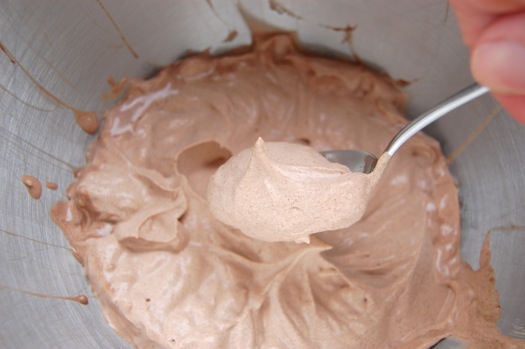
Whip the cream the rest of the way, somewhere between soft and stiff peaks, according to your liking.

You’ll need to use this within about half an hour, which is when the gelatin will start setting up, making smooth spreading more difficult. Consume any leftovers on scones.

Filed under:  Pastry, Stabilized Whipped Cream, Stabilized Whipped Cream | 10 Comments

Prune Filling

Another fantastic kolache filling that works just as well in Danishes. Funny how that works, isn’t it? You need:

2 cups dried prunes
water or prune juice to cover
2 tablespoons sugar
1 tablespoon lemon juice
zest of 1/2 lemon
1/2 teaspoon ground cinnamon
pinch ground cloves

Place the prunes in a small saucepan and add water or prune juice to not-quite cover. Bring the mixture the boil, turn off the heat and let stand for 20 minutes. Cool the prunes and remove any pits. Here I’m working a half quantity.

Remove the prunes to a food processor. Add the remaining ingredients and blend to a slightly chunky paste.

Done!

Filed under:  Pastry, Prune Filling | 8 Comments

Poppy Seed Filling

This is a classic kolache filling, but also works well with Danishes and various kinds of sugar cookies.

1 cup poppy seeds
1 cup water
1/4 cup sugar
zest of 1/2 lemon
1 teaspoon cornstarch or flour

Bring the water to the boil and add the poppy seeds. Simmer covered for 20 minutes. Let the seeds stand about 15 minutes, drain them well (pour off any excess water and press them with the back of a spoon…or pour the while thing through a very fine med strainer or cheese cloth). Stir in the sugar, lemon zest and cornstarch (or flour).

If you can’t find poppy seeds in bulk anywhere, canned filling works fine. I stir in some fresh lemon zest to brighten the flavor.

Filed under:  Pastry, Poppyseed Filling | 2 Comments

Cottage Cheese/Farmer’s Cheese Filling

Great for kolaches or blintzes, this recipe would certainly have been a farmer’s cheese recipe back in the Old Country. In the States fresh country cheeses like that are harder to come by. Cottage cheese a a reasonable facsimile. Either need to be combined with cream cheese to keep them from weeping. If you’d like a lighter fat version of this, use all cottage cheese/farmer’s cheese and stir in 1/4 cup of tapioca powder.

8 ounces (1 cup) small curd cottage cheese or farmer’s cheese
8 ounces (1 cup) cream cheese
1.75 ounces (1/4 cup) powdered sugar (optional)
1/4 teaspoon vanilla (optional)

Combine all in a small bowl and stir! You can 2 egg yolks if you like a more custard-ish result (assuming the filling is going to be baked).

Filed under:  Cottage Cheese/Farmer's Cheese Filling | Leave a comment

Making Chiboust

Call it chi-BOOST, call it she-BOO, it’s a sweet, light and delicate filling either way. Pastry cream lightened with Italian meringue is what it is, and it works well in just about any context where you want a large volume of filling, but don’t want to overwhelm the eater with richness or heaviness. A Paris-Brest is a good example, or a Gâteau St. Honoré. Bear in mind that chiboust — like most meringues — doesn’t like humidity. And while it can be piped, pipe it only through large-bore nozzles, since constriction and pressure causes it to deflate and go runny. Here I have about a cup of the firmer of the two pastry creams that are up on the site.

To that I’ll add a roughly equal amount of Italian meringue

…and fold it in. Then another equal quantity of meringue…

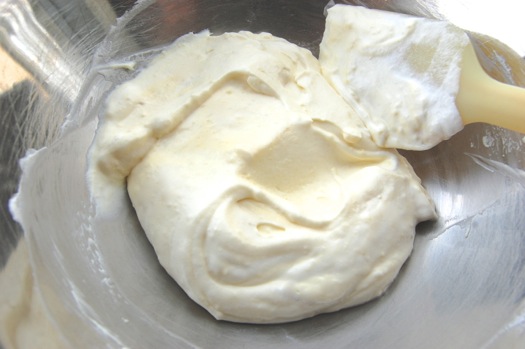
…and finally another until I’ve got something that looks about like this.

And ze she-boo, she iz done!

Filed under:  Chiboust, Pastry | Leave a comment

Lenôtre Pastry Cream

Just because a component fails in one application doesn’t mean it isn’t good for another. This preparation is too thin and creamy for use in a layered pastry, but would be excellent as a filling for éclairs, in Paris-Brest or in any number of other applications where its eggy silkiness would be an asset. It’s made from whole milk, so it’s a bit lighter than a standard pastry cream (often made with half heavy cream), and even though it has the same amount of sugar it doesn’t taste as sweet. To make it you’ll need:

the seeds of 1 vanilla bean
32 ounces (1 quart) whole milk
8 ounces sugar (1 cup plus one tablespoon)
12 egg yolks
2 ounces (1/4 cup) cornstarch

Start by combining the seeds of the vanilla bean with the milk in a medium saucepan and bring it to the boil.

Give it a good whisk every so often.

Meanwhile, combine the yolks and sugar in the bowl of a mixer fitted with the whip.

Whip on high for about three minutes until a thick ribbon drips off the whip.

With the mixer running on medium-low, add the cornstarch in a steady stream. Scrape the bowl to make sure it’s all incorporated.

Now add the hot milk in a steady stream.

When it’s completely incorporated, pour the whole works back into the saucepan…

…and whisking steadily, bring the mixture up to boiling. Let it bubble — not violently — for about 45 seconds to a minute.

Pour it into a bowl, and allow it to cool for about ten minutes. Don’t worry about the foam, it’ll subside eventually.

Lay on some plastic wrap to prevent a skin from forming. About half a tablespoon of melted butter will accomplish the same thing.

If you make the full recipe, you’ll want to cool the bowl in an ice bath, then put it in the refrigerator. A half recipe will cool down enough in half an hour to be placed in the fridge on its own.

This is kind of a neat method, isn’t it? The all-in-the-mixer “whipped egg” technique creates a lighter and more elegant product than the standard whisk method, plus you don’t get any thick curds…eet iz very nice. But not for Napoleons.

Filed under:  Pastry, Pastry Cream, Pastry Cream | 4 Comments

Making Praline Paste

Perfectly smooth, commercially-made praline paste is ubiquitous in many parts of Europe. Here in the States it’s virtually unknown. However once you taste it I have no doubt it will quickly attain a place of prominence in your spread pantheon — alongside nutella, peanut butter, jam and, for you Aussies and Brits, vegemite and marmite. It’s also very handy as a pastry ingredient, obviously. Begin with the praline. Lay the nuts out on a lightly oiled sheet of parchment paper.

Then make the caramel. Combine the sugar and the water in a pan…

…and swirl over high heat until it’s the darkness you prefer. I wait until I see wisp of smoke or two since I like mine with a slightly more pronounced flavor. Most people prefer theirs a slightly lighter amber.

Anyhow…pour the caramel over the nuts and allow the caramel to cool completely.

When cool, break up the praline and put the pieces in your food processor (you can also first break down the praline by putting it in a plastic bag and hitting it with a mallet, that will save some wear and tear on your food processor blades if you decide you want to do this a lot — thanks to reader Ed for the tip!).

Start processing the praline. After about 30 seconds or so you may start to wonder if you’ve done something wrong, since it pretty much stays a bunch of crumbs.

However after another 30 seconds or so you’ll start to see that the oil is leaking out of the chopped nuts and beginning to create a more butter-like mixture.

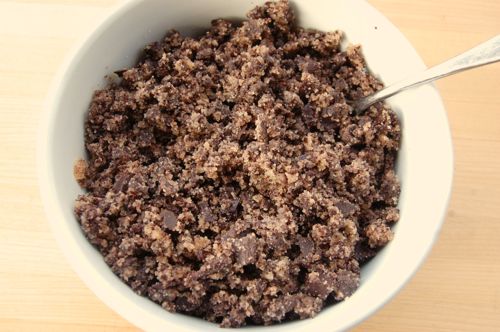
Another 30 seconds or so and you should have something that resembles home-made peanut butter. If not, if you’re having a hard time breaking down the praline, you can prime the pump with a tablespoon or two of oil. A nut oil is ideal (walnut oil, say), though a less expensive oil like peanut will work very well too. Failing that, a neutral vegetable oil will work just fine.

To reduce the particle size still further you can take this paste for a spin in your blender. That’s what I did to get my final, barely grainy consistency. But you may decide after tasting it that you don’t need to take things to that degree. It tastes amazing either way. Oh, and did I mention that for a subtle, slightly salty taste that sets the caramel off even more, you might want to add a quarter teaspoon or more of salt? I didn’t, no. Shame on me.

Filed under:  Pastry, Pastry Components, Praline Paste, Praline Paste | 22 Comments

Praline Paste Recipe

People tasting praline paste for the first time tend to fall to their knees and weep for all the wasted years. For while it is an ingredient, it’s also a spread in its own right, a sweet nut butter with strong caramel overtones. You’ll need to resist the urge to keep spooning it into your mouth until it’s gone. The formula is elementary: 1-1 sugar to nuts by weight, but most people like to divide the proportion of nuts between blanched almonds and hazelnuts. So let’s say, for purposes of argument, you wanted to make a pound of praline paste for a mid-day snack. You’d use:

8 ounces granulated sugar
1/4 cup water
4 ounces blanched almonds
4 ounces hazelnuts (peeled makes the best presentation)

Place the nuts on a sheet of lightly greased parchment paper or a silpat. Then simply add the water to the sugar in a small saucepan and heat it over high heat, swirling until the mixture turns to caramel. Dark amber is usually the degree most pastry makers cook to, though you can go darker for a stronger flavor. Pour the caramel over the nuts and allow the mixture to cool completely. Then break the praline into pieces and grind them as finely as you can in a food processor until a paste forms. It won’t be as smooth as commercially-made praline paste, but the flavor will be, well…you’ve got to try this stuff to believe it. If you want to absolutely go nuts, add in:

2 ounces melted dark chocolate

…during the final blending step.

Filed under:  Pastry Components, Praline Paste, Praline Paste | 7 Comments

Sweet Potato Filling

Sweet Potato Filling

1 lb. sweet potatoes, peeled and cut into 1” cubes
1 medium onion, sliced
1 tablespoon olive oil
2 tablespoons butter
2 tablespoons milk
Salt and pepper to taste

A great New-World twist on a classic potato blintz filling. Preheat your oven to 350. Toss the sweet potato cubes with the olive oil in a baking dish and and bake for about 1 hour, until the potatoes are tender. Meanwhile, chop the onion, and sweat them in a sauté pan with the butter until translucent but not brown. Mash the potatoes with the milk in a medium bowl and add the onions. Season with salt and pepper to taste.

Filed under:  Pastry, Sweet Potato Filling | Leave a comment

Meat Filling

Meat Filling

2 tablespoons butter or vegetable oil
1 small onion
1/2 pound ground beef or finely chopped brisket
2 tablespoons finely chopped fresh parsley
1 tablespoon tomato paste
salt and pepper pepper to taste

This classic blintz filling can be customized as you see fit. Chop the onion finely and sweat it in a sauté pan with the butter until translucent but not brown. Set aside. Add the meat to the pan and sauté until browned. Strain the fat, then add the onion back to the pan along with the parsley and the tomato paste. Stir to combine, adding and salt and pepper to taste.

Filed under:  Meat Filling | Leave a comment