Category Archives: Cake Layers

Making Red Velvet Cake

There’s only one absolutely critical thing you need to remember when making red velvet cake: wear an old shirt. Other than that it’s much like making a basic yellow butter cake. The odd alchemical steps you find in many traditional recipes really aren’t necessary. Plenty of food coloring and a little cocoa is the extent of the juju.

Which is not to say that red velvet cake is indiscernible from yellow cake in the mouth. The quarter cup of cocoa does create a distinctive taste and texture, and the food coloring itself brings a few unique hints of flavor to the party. Begin by preheating your oven to 350 degrees Fahrenheit, assembling your ingredients and preparing two 9″ cake layer pans. Combine the dry ingredients in the bowl of a mixer fitted with a paddle (beater). Stir it all on low for about 30 seconds.

Add the soft butter and stir on medium speed for about a minute.

Add one cup plus two tablespoons of the room-temperature buttermilk, and raise the speed to medium-high. Beat the batter for 90 seconds.

Next combine the yolks and the food coloring. I grant you, this looks a little disgusting.

Add 1/4 cup of the buttermilk and stir it all together.

Add it by thirds to the batter, beating in each addition for 20 seconds.

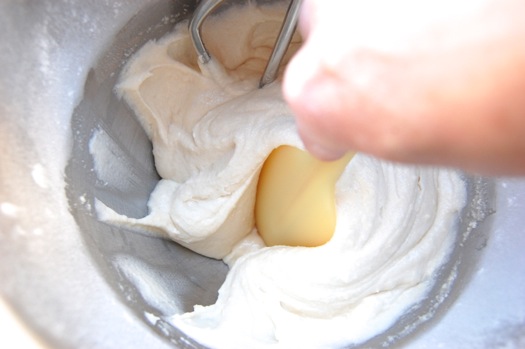
Be sure to do plenty of scraping.

Then scrape the batter into the prepared pans. About 21 ounces of batter per layer.

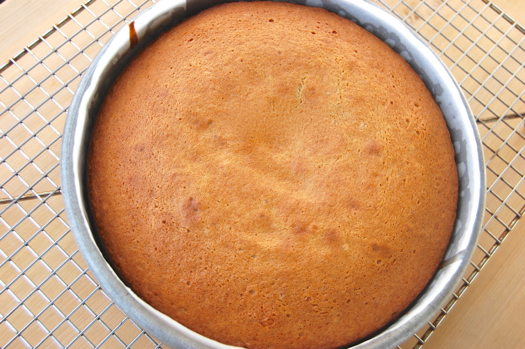
Bake until they’re firm in the center, 25-30 minutes.

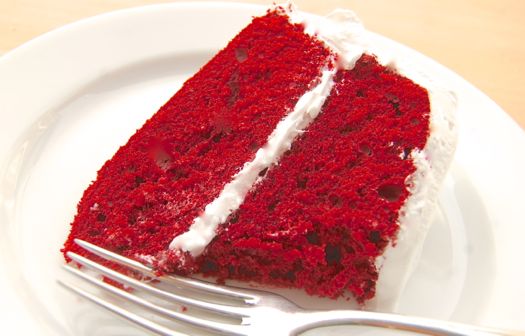
Cool the layers on a rack for ten minutes, then turn them out to cool completely before using. Red velvet layers can be combined with any number of frostings. Here I’m using a standard seven-minute frosting, but “heritage” a.k.a. “boiled” a.k.a. “flour” a.k.a. “cooked flour” a.k.a. “gravy” a.k.a. “cloudburst” frosting is popular, as is cream cheese. Just so long as it’s white!

Filed under:  Pastry, Red Velvet Cake | 50 Comments

Red Velvet Cake Recipe

This should work…at least in theory, so maybe let me try this before you do. A lot of creative balderdash surrounds the red velvet cake, from its origin myths to its chemistry to its odd little preparation rituals (making a paste of red food coloring and cocoa powder, etc.). There’ll be more on all that this week. For now all you need to know is that red velvet cake is nothing more than a buttermilk layer cake with a hint of chocolate and a whole lot of red food coloring. It goes like this:

6 large egg yolks
11 ounces (1 1/4 cups plus two tablespoons buttermilk)
2 teaspoons vanilla
2 ounces red food coloring
13 1/2 ounces (3 cups) cake flour, sifted
10 1/2 ounces (1 1/2 cups) sugar
1/4 cup cocoa powder
3/4 teaspoons baking powder
3/4 teaspoons baking soda
3/4 teaspoon salt
12 tablespoons unsalted butter, softened

Begin by preheating your oven to 350˚F. Combine the yolks, vanilla, 1/4 cup of the buttermilk and the red food coloring and beat lightly to blend. Pour the sugar into the bowl of a stand mixer, then sift the flour and the leavening together into the bowl. Add the cocoa powder and the salt. Turn the mixer on low and blend the dry ingredients for about one minute. Add the soft butter and the remaining nine ounces of buttermilk. Slowly raise the mixer speed to medium and beat for 1 1/2 minutes until the batter is smooth and uniform. Scrape down the bowl.

Now begin to add the yolk mixture. Pour in about 1/3 of it, beat the mixture at medium speed for 20 seconds, then thoroughly scrape the bowl, paying particular attention to the bottom by the dimple. Continue on in that fashion until the entire yolk mixture has been incorporated. Divide the mixture between the two pans. Bake for 25 minutes, then check the layers. If the middle seems slightly sunken and mushy to the touch, continue to bake for another 7-10 minutes.

When fully baked, place the layers, in the pan, on a wire rack to cool. After 15 minutes, turn them out onto the rack to cool completely, about another hour.

Filed under:  Pastry, Red Velvet Cake | 20 Comments

Making High Ratio Yellow Cake

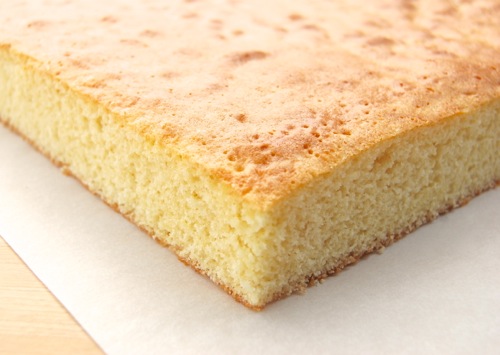
Sheet cake lovers, this is your cake. It’s as close as you can get to a commercial sheet cake consistency without the high ratio flour and emulsified shortening that the pros use. It’s great for stacking and decent for carving (though if you really want to get serious about cake theatrics you’ll want to do a google search for “durable cake recipe”). But of course the main reason people like a sheet cake is for the decorating potential. Quite a canvas they present, oh yes they do.

This recipe is formulated for a 9″ x 13″ x 2″ cake pan, and I can’t stress enough that if you want to make a sheet cake you need to use a square-cornered sheet cake pan. Not a casserole dish, which creates mounds at the edges of the cake with a depression in the center. Start by preheating your oven to 350 degrees Fahrenheit and getting your ingredients together. Grease your pan and line it with parchment paper for easy extraction.

Next sift the flour into a large bowl.

Add HALF the sugar, the baking powder and salt…

…and whisk it all together. Set it aside.

Next combine the room-temperature milk, vanilla and vegetable oil. Set that aside as well.

Now combine the shortening with the rest of the sugar.

Beat that on medium high for 2-3 minutes until it’s very light and fluffy (this step is key to a good emulsion so you may want to scrape at least once as you do the creaming). Now start adding the eggs one by one, as well as the yolks. Scrape several times to make sure you’ve got complete incorporation. If the mixture looks lumpy or curdled, proceed since it’s no big deal. At all.

Now add a third of the flour, stir on medium-low, scrape and stir some more.

Add half the milk mixture and stir that in. Add another third of the flour, stir, scrape and all that. Proceed like this until everything is combined and the batter is smooth, but don’t go too nuts on the beating (gluten development, donchaknow). You just want everything evenly combined.

Scrape the batter into your prepared pan and bake 30-40 minutes until the center of the cake springs back when it’s tapped.

Allow the cake to cool ten minutes before you turn it out. Place a rack on the top and flip the whole works over. Put another rack on the cake and flip it back, removing the original rack when you’re done. Let it cool completely before you trim and decorate.

Alternately you can do reader Frank’s trick of just leaving the cake upside-down and enjoy that nice smooth top and the square corners!

Filed under:  Yellow High-Ratio Cake | 18 Comments

Making High Ratio Chocolate Cake

For those looking to imitate the sort of chocolate cake you get from a boxed mix, or you want a chocolate sheet cake like like you’d get from a larger commercial bakery, this is your ticket. This cake has the tight crumb and relative durability you want, plus it bakes up well in broad cake pans. This formula is enough for one 11″ x 14″ x 2″ sheet cake pan or three 8″ x 2″ round layer pans. It can be easily scaled up or down depending on your needs.

First, preheat your oven to 350 degrees Fahrenheit and grease your pan(s). Here’s I’ve also lined this big 11″ x 14″ with parchment for easy extraction. I recommend it.

To begin your batter, bring the water to a simmer and combine it with your cocoa powder:

…and whisk it thoroughly. Allow that to cool, then add the vanilla.

Next, sift the cake flour into a large bowl.

Add half the sugar, the salt and the baking soda and baking powder.

Whisk it. Whisk it good.

Next combine the other half of the sugar and the shortening in the bowl of a mixer.

Beat that for 2-3 minutes on medium-high until it is extremely light and fluffy. Scrape the bowl down…

…and start adding your eggs one by one, then your yolks. Beat thoroughly after each addition and scrape regularly. If the batter develops a clumpy or curdled look, fear not and press on.

Once everything is beaten and scraped, add a third of the flour.

Stir that in on medium-low, then add half the chocolate mixture. Yours will be thinner than this (I added more liquid after the fact because I didn’t have enough in there). Stir, add another third of the flour, stir and scrape. Keep going in this manner until everything is incorporated and the batter is smooth (you don’t want to over mix, so don’t go hog wild on the stirring).

Scrape the batter into your pan(s) and spread it around evenly.

Bake for 35-40 minutes until it looks about like this.

Allow it to cool about ten minutes, then place a cooling rack on top and flip everything over. The layer will drop out. Place another rack on the bottom, flip everything back again and remove the rack from the top. Allow the cake to cool completely before decorating. The top of the cake probably won’t be perfectly even. I like to trim off the outer half inch completely, then shave any bulges off the top with a serrated knife before I start to frost it.

Filed under:  Chocolate High-Ratio Cake, Pastry | 31 Comments

High Ratio Chocolate Cake Recipe

As with the high ratio yellow cake recipe, emulsification is king here. The recipe is built accordingly, making a process allowance for the cocoa powder. An interesting feature of cocoa powder is that it delivers double the chocolate flavor if you combine it with boiling milk or water before you add it to your mix (another trick from the world of box cake formulators). Since I can’t abide wasting perfectly good chocolate flavor, I’ll be doing that.

I should add that this cake can be made with butter if you wish. As it is it won’t be exactly like a commercial cake because most of us don’t have access to emulsified shortening or high ratio flour, which are usually used to make high ratio cakes. But butter will work here. For more moisture you can substitute oil for some of the fat (olive oil is best since it also adds emulsifiers and tightens the crumb. This recipe will make three 8″ round layers or one 11″ x 14″ x 2″ sheet cake (I should add that if you’re baking in a pan of that size, but the soda back by 1/4 teaspoon to help ensure the cake doesn’t fall in the middle)

13 ounces (1 1/2 cups + 2 tablespoons) boiling water
1.65 ounces (1/2 cup) cocoa powder
1 tablespoon vanilla extract
13.5 ounces (3 cups) cake flour
1 1/2 teaspoons salt
1 tablespoon baking powder
1 1/2 teaspoons baking soda (1/4 tsp. less if you’re making a large sheet cake)
15 ounces (2 cups, 2 tablespoons) sugar
6.75 ounces (1 cup) shortening
3 eggs
6 egg yolks

Preheat your oven to 350 degrees. Pour the water into a small saucepan and bring to a simmer. Whisk in the cocoa powder until it’s completely incorporated and allow the mixture to cool. Add the vanilla. Sift the flour into a large bowl, add the salt, baking powder, baking soda and HALF the sugar. Set that aside also. Next, combine the remaining sugar and shortening in the bowl of a stand mixer fitted with the paddle (beater) and cream them thoroughly, about two minutes. Beat in the eggs one at a time, then the yolks all at once. Stir in about a third of the flour, then half the chocolate mixture, another third of the flour, etc. until everything is incorporate. Scrape the mixture into a greased 9″ x 13″ cake pan and bake about half an hour until the cake springs back in the middle when touched.

Filed under:  Chocolate High-Ratio Cake, Pastry | 23 Comments

High Ratio Yellow Cake Recipe

The name of the game in high ratio cake recipes is “emulsification”, which means an extremely smooth and integrated mixture with all the ingredients distributed as finely and uniformly as possible. That’s how the very fine and strong crumb of a commercially made cake layer is achieved. Most people don’t have access to the high ratio flour and emulsified shortening that commercial bakeries use, so I’m adding adding extra emulsifiers in the form of egg yolks. What are emulsifiers? Simply little whatsit molecules that get between other molecules and keep them from forming big clumps. A key to this is making sure all your ingredients are room temperature, since egg yolk emulsifiers don’t work well when they’re cold.

This cake works for a number of applications, from small layers to doughnuts to sheet cakes. For larger sheets, you’ll want to subtract a bit of the leavening to help keep the rise under control and prevent the center from falling. The recipe goes like this:

6.75 ounces (3/4 cup + 1 1/2 tablespoons) milk, room temperature
1 tablespoon vanilla extract
1 ounce (2 tablespoons) vegetable oil
13.5 ounces (3 cups) cake flour
1 1/2 teaspoons salt
1 tablespoon baking powder (1/4 tsp less if you’re baking a large sheet cake)
15 ounces (2 cups, 2 tablespoons) sugar
6.75 ounces (1 cup) shortening (butter can also be used).
3 eggs
6 egg yolks

Preheat your oven to 350 degrees Fahrenheit, grease a 9″ x 13″ pan and line it with parchment. Combine the milk, vanilla and oil in a bowl and set aside. Sift the flour into a large bowl, add the salt, baking powder and HALF the sugar. Set that aside also. Next, combine the remaining sugar and shortening in the bowl of a stand mixer fitted with the paddle (beater) and cream them thoroughly, about two minutes. Beat in the eggs one at a time, then the yolks steadily. Stir in about a third of the flour, then half the milk mixture, another third of the flour, etc. until everything is incorporate. Scrape the mixture into a greased 9″ x 13″ cake pan and bake about half an hour until the cake springs back in the middle when touched.

Filed under:  Pastry, Yellow High-Ratio Cake | 31 Comments

Making Caramel Cake

Many a little old lady has trodden caramel cake territory. Go there and you’ll find yourself getting in touch with your inner granny, the one with the heavy orthotic shoes, lace collar and tinge of blue in her hair. I did and I can tell you that it made me a better baker. However later I found myself complaining about street crime, the rudeness of pharmacy clerks and the scandal of mini skirts. It was a double-edged sword.

This is a sweet, rich layer cake that demands some time, though not more than any loving octogenarian would be willing to devote. So no excuses, K? Start by preparing three layer pans for baking. If you don’t have a third good one, a springform pan will fill in well here. Next, preheat your oven to 350 degrees Fahrenheit. That done, sift your cake flour into the bowl of a stand mixer.

Add in the sugar, salt and leavening.

Stir it all together on low, then add the soft butter. Stir on medium-low until it’s incorporated.

Next add 3/4 cup milk and beat on medium high for about 90 seconds.

Scrape the bowl well.

Combine the remaining milk with four of the egg whites and the vanilla and whisk it all together with a fork.

Pour in about a third. Beat the batter for about 10 seconds on medium high.

Scrape…add another third, beat, scrape, you get the idea.

When the batter is homogenous scrape it into a large bowl.

Wash out the mixer bowl and add the egg whites. Don’t go crazy with the washing and such. The idea that even the tiniest speck of fat will ruin an egg foam is a myth. A hot rinse and a wipe-out are fine.

Whip the egg whites to soft peaks.

Fold them into the batter and you’re ready to roll.

Scrape an equal amount of batter into the three pans. For those who are weighing, it’ll be about 21 ounces per.

Bake them about 30 minutes until they’re lightly browned and springy to the touch. Let them cool about 20 minutes…

…then invert them onto a wire rack to cool completely, about another half hour. If I were going to do this a second time I’d put a sheet of parchment down since the top crust is a little sticky. The three layers can be frozen at this point for up to a couple of months. I generally like freezing layers for at least a short while since it makes it easier to trim and top them, a step I also recommend.

When you’re ready to assemble the cake, prepare your icing. Put one layer down on a cardboard round or cake circle and pour on about a cup and a half of icing. Spread it around a little, stack on the third layer and repeat.

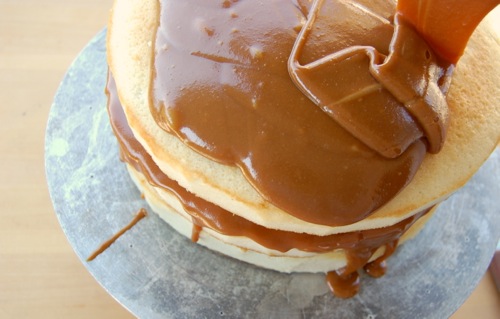
When all the layers are on, pour most of the rest of the thickened icing over the top (you’ll have extra). Had I been thinking clearly at this step I would have transferred it to a wire rack sitting a sheet pan, instead of just leaving it on my cake wheel here. Unfortunately I had a kindergartener and a third grader behind me just then, and they were arguing. I was too busy threatening them with a loss of Bugs Bunny privileges, and it got messy.

Promptly cover any bare patches before the icing firms too much.

Allow the icing to firm at least half an hour (more is better) before slicing and serving. This is good stuff. Had parental discipline not prevented me last evening, I would have cut and photographed the cake right away while the icing laters were perfectly distinct. However I waited until this morning, at which point I saw that the icing had soaked into the cake a bit. It’s not a big deal, but it looked perfect last evening and as an uptight sorta guy, I prefer perfect when I can get it.

C’est la vie, eh? But it tasted just like it would have had my grandma ever made it. But she didn’t. Oh, the wasted years.

Filed under:  Caramel Cake, Caramel Cake, Pastry | 25 Comments

Caramel Cake Layers

Here we have a caramel cake made the truly old-fashioned way. This one is lighter than the one I initially discovered, but I think it’ll still be delectable. Let’s see how it turns out!

16 ounces (4 1/2 cups) cake flour
1 tablespoon baking powder
1 1/2 teaspoons salt
21 ounces (3 cups) sugar
16 tablespoons (2 sticks) soft butter
8 ounces (1 cup) milk, room temperature, divided
8 egg whites, room temperature, divided
1 tablespoon vanilla extract

Preheat your oven to 350 degrees Fahrenheit. Prepare three layer pans according instructions here. Sift the flour into the bowl of a stand mixer. Add the sugar, baking powder and salt and stir on low to combine. Add the butter and 3/4 cup milk and beat for 90 seconds on medium speed. Scrape the bowl. Combine the remaining 1/4 cup milk with four of the whites and the vanilla. Beat this into the better in three additions, beating for 20 seconds each time. Transfer the batter to a large bowl and wash and dry the mixer bowl well. Beat the remaining 4 whites to soft peaks and fold them into the batter.

Scrape the batter into the prepared pans and bake for 25-30 minutes, untilt he tops of the layers spring back when you tap them in the centers. Cool the pans on wire racks for 15-20 minutes, then turn the layers out to cool completely. Once cool these layers can be frozen for easier handling or for storage, up to two months.

Filed under:  Caramel Cake, Caramel Cake, Pastry | 9 Comments

Carrot Cake

Since childhood I’ve been amazed at the way carrots transform themselves when baked into a cake. You don’t even know they’re there. I remember thinking when I was a boy: someone’s gotta be pulling my leg. This carrot cake is a far cry from the overly dense, overly moist cakes that I ate as a kid in the 70′s. And it’s not because the cake doesn’t have much carrot in it — there’s a full pound in there. It’s light and pleasing even so. Add frosting to it or don’t, either way it’s very worthwhile.

Begin by preheating your oven to 350. You’ll also want to line two 9″ cake layer pans with baking parchment according to these directions. Once that’s done, coarsely grate a pound of peeled carrots.

Pour your flour into a sifter (strainer) situated in a bowl on a scale.

Once you have the right amount, sift the flour into the bowl.

Add the leavening, spices and salt…

…and whisk it together with a fork.

Now for the wet stuff. Combine the sugars, eggs, oil and vanilla in the bowl of a mixer fitted with a paddle.

Beat the mixture on medium speed about 45 seconds until it’s well blended, then add the flour all at once.

Turn the machine down to medium-low and stir in the flour — about 30 seconds, until it’s barely been incorporated. Then scrape down the sides to make sure there’s no unincorporated flour anywhere in the bowl.

Add the carrots.

Stir those in for 10-15 seconds, as well as the raisins or nuts if you’re using them. Scrape the batter into the prepared pans…

…and bake 45-55 minutes until a cake tester or knife inserted into the center of the cake comes out clean.

Cool the cakes in the pans for about 10 minutes, then turn the layers out onto a very lightly greased parchment-lined rack (this will keep the tops from sticking to the rack). Peel off the parchment. Eat the cakes plain (very nice) or press on and make a layer cake.

Since these layers usually turn out quite flat on top and mostly square, there’s usually no need to trim them up as with butter cake layers. Simply apply one of the layers to a cardboard cake circle, put the circle on a revolving cake stand (three stationary cans of soup or vegetables will also work well as an elevated base) and ice the cake with one recipe of cream cheese frosting.

Refrigeration will firm up the frosting some if you wish. If not — eat!

Filed under:  Cake Layers, Carrot Cake, Carrot Cake, Pastry, Pastry Components | 1 Comment

Carrot Cake Recipe

The nuts and bolts of this cake recipe are pure Rose Levy Beranbaum, as found in her latest book, Rose’s Heavely Cakes. It differs mainly in the spicing, since in my universe a carrot cake is really a classic spice cake dressed up in hippie garb. This cake is moist but not overly so, and has just the right amount of richness to it. Mixed via the muffin method, it’s also a snap to prepare. The formula goes like this:

10.5 ounces (generous 2 cups) all-purpose flour, sifted
1 ½ teaspoons baking powder
1 teaspoon baking soda
1 ¼ teaspoons salt
1 teaspoon cinnamon
½ teaspoon ground nutmeg
¼ teaspoon ground clove
10.5 ounces (1 ½ cups) sugar
3.5 ounces (scant ½ cup) light brown sugar
9 ounces by weight (1 ¼ cups) canola oil
4 room-temperature eggs
2 teaspoons vanilla extract
1 pound (3 cups) coarsely grated carrot
1 cup raisins or nuts (optional)

Before you begin, you’ll want to get two 9″ layer pans lined with parchment paper and lubricated (see this tutorial for more on that). Preheat your oven to 350.

Combine the flour, leavening, salt and spices in a medium bowl and whisk to combine them. Put the sugar, oil, eggs and vanilla in the bowl of a stand mixer fitted with the paddle and beat for about a minute on medium speed until thoroughly combined. Add the dry ingredients all at once and beat on medium low another 30 seconds until the flour mixture just barely disappears. Add the carrots and stir them in (add the nuts or raisins at the same time if you’re using them). Scrape the batter into the prepared pans, you’ll have about 28 ounces in each layer. Bake 45-55 minutes until a knife inserted in the center of the cake comes out clean. Let the layers sit for ten minutes, then turn them out onto a parchment-covered rack to finish cooling, about an hour.

Filed under:  Cake Layers, Carrot Cake, Carrot Cake, Pastry, Pastry Components | 10 Comments