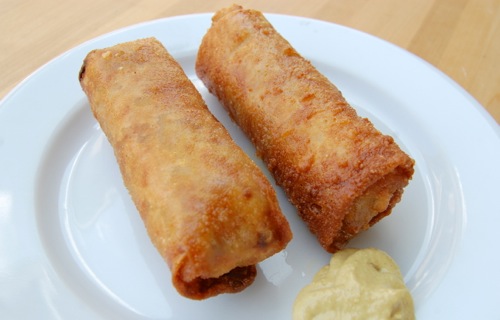
Now me, I grew up calling these sorts of devices “egg rolls.” It wasn’t until I got to be in high school that I began to know them as spring rolls. That was when one of my father’s oldest friends married a Chinese woman who happened to own one of the best Mandarin restaurants in Chinatown. We started eating there once a week, so I had to at least appear to know the lingo. These below are what I always thought were “spring rolls”:

Turns out they’re both spring rolls, the difference is of course that up top we have fried spring rolls versus merely the rolled-up variety. Truth be told I still call them “egg rolls” when there’s no one around to correct me. Both are a lot of fun to make, mostly because the technique for making the skins is so ingeniously odd. You basically pick up a big blob of dough, dab it onto a pan and pick it up again. The film that remains is the wrapper. Cool eh? Ultra-thin pastry is really fascinating stuff.
Anyway, the name of this game is “developed gluten.” Without it the dough film won’t adhere to the pan. So you’ll need bread flour for sure, high gluten flour if you can find it. The recipe proceeds like this so. Combine your flour, water and salt in the bowl of a mixer fitted with the paddle.

Stir that until a lumpy dough forms, about two minutes.

Now for something unusual. Pour in enough water to cover the dough you just made. Then stick the mixer bowl in the refrigerator overnight.

The next day pour off the excess water.

Re-attach the bowl to the mixer, put on the paddle and start to beat the dough on medium-high speed. Those of you who have ever made focaccia will recognize this process. The dough starts out sticking to the sides of the mixer bowl…

…than after about 15 minutes it suddenly gathers around the paddle in a shiny mass.

When you see this, you’re done:

Now heat a pan over low heat. You want the temperature quite modest here, about 200 – 220 degrees Fahrenheit. I know, few if any of you have a laser thermometer handy. Another way to gauge the right temperature is to lightly touch your finger to the pan. You should be comfortable leaving it there for about a second (“one Mississippi).

Reach into the mixer bowl and pull out the dough. It will be very floppy but all that activated gluten will make it want to hold together in one blob. You can brandish the whole thing at once or squeeze off a large piece.

Then…juggling the whole mass in your hand…plop! Hit the pan with the dough. Swirl it a tad. Told you this was fun, didn’t I?

Pull it up immediately, it will come away like a large mass of glue, leaving a film like this.

Smooth out any lumps very gently with a spatula.

When the edges curl up the skin is done. Get under it with a spatula…

…then peel the whole thing away. I got a lot of rough edges with mine, but hey, I’m a first-timer. Plus rough edges don’t matter when you shape your rolls. Just stack them on a nearby plate covered with with damp cloth or piece of plastic wrap. They’ll be somewhat rigid at first, but will become very supple after about an hour of sitting.
Let then pan cool down again before starting the next one. About 30 seconds is good. Let it re-heat about five seconds and do the temperature test again.

To roll a spring roll, lay a skin down on a work surface. This one looks pretty ragged, but it doesn’t matter a bit. Lay on a few tablespoons of filling.

Roll it half way then fold in the sides…one…

…two.

Roll it up the rest of the way and you’re done. See?

Serve them as-is or deep fry them in peanut or vegetable oil at 375 degrees Fahrenheit. You’ll want to seal the edge with a little raw egg before you do that to keep them from unraveling. Drain well and serve with horseradish mustard.
This recipe will make a whole lot of skins, but I made it large so you’d have some extra. As you get good at it, you can cut it down by a third. Oh, and did I mention these skins freeze very, very well? Indeed they do, so you can make a bunch now and store plenty away for the next Chinese meal.