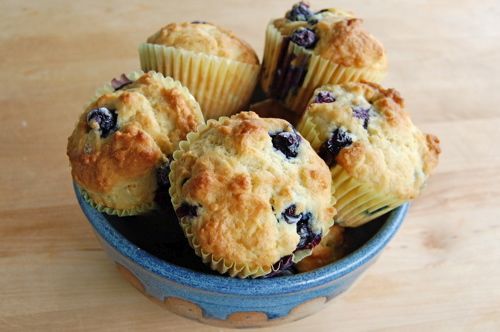
There’s a big misconception out there that muffins are supposed to have highly domed, even conical tops. Nonsense. A peaked top is a sure sign that a muffin has been over-mixed, and that means it’ll be chewy, even gummy to the tooth. That’s not a good muffin in my book. I prefer them melt-in-your-mouth tender. Just out of the oven, when they have a touch of crispness on them, they’re a sort of an American version of paradise.
They’re mixed, unsurprisingly, via the muffin method. That’s a fast-and-easy technique that you’ve probably used before. It simply means combining (gently) two mixtures: the wet ingredients and the dry ingredients, then panning and baking. Easy! So let’s go. Preheat your oven to 350 degrees Fahrenheit. Next sift/whisk together the flour, salt and baking powder in a large bowl. That’s the dry side of the equation.

Now for the wet side. Combine the butter and the sugar (yes, that’s classified as “wet” since it dissolves so quickly in water) in a bowl.

Beat those together until they’re fluffy, then beat in the egg, sour cream and milk.

It’ll look about like this:

Now all you have to do, spatula in hand, is apply the wet ingredients to the dry ingredients.

Gently mix everything together.

You’ll want to just bring the mixture together. If you see a few spots of unmixed flour left, so much the better.

Add in the berries and gently fold them in as well, just until they’re evenly distributed.

Now all you need to do is fill your forms with batter and bake! You don’t need to use cupcake liners if you don’t want to do that. Just make sure your form is well lubricated.

While the muffins are baking you can get a window into how well you mixed as you wash up. Pay attention to the behavior of the residual bits of batter as you wash out your bowl. If the batter simply dissolves in the water stream, you’ve got a superior muffin to look forward to. If it puts up a fight or leaves stringy/rubbery deposits on your wash cloth or sponge, you’ll want to ease up on elbow grease next time, killer.
This is what you’re after: a tight crumb with a few irregular holes, but no “tunnels” caused by gluten formation. I think I’ll put the kettle on.