Powdered Sugar
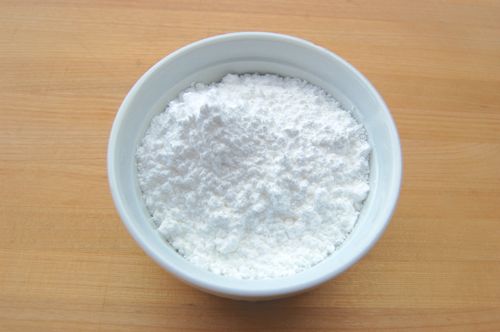
Powdered sugar has the smallest crystal size of any of the white sugars, as small as 0.01 millimeters. It’s also known as “confectioner’s” or “icing” sugar depending on where you live. The tiny crystals make it good for dusting and of course making frostings and icings. The only major drawback to powdered sugar is its flavor and texture which can be chalky. The reason, because powdered sugar contains up to about 3% corn starch, which is there to absorb moisture and keep the tiny crystals from clumping.
The brand icing sugar I get where I live is a UK product which lists E341 (Tricalcium Phosphate) as the anti-caking agent. I always used to wonder about the chalky texture I used to read about until someone brought me a bag of Domino brand confectioner’s sugar from the US. I made a simple water icing with it and compared to what I was used to it had a slightly soapy taste (if soapy is the best way to describe it) and it somehow seemed less sweet.
As an addition, in Australia we also have “pure icing sugar”, which (I believe) has no caking agent and a superior taste by far
Interesting. I don’t think we have that here. I wonder how it retains its consistency?
I’ll see if I can find out, Rick!
– Joe
Rick is correct. Pure icing sugar is exactly what it says on the label. It is powdered sugar with no additives. It goes lumpy very soon after opening so I only buy it when I have a specific need, such as royal icing. The rest of the time I use icing sugar mixture, which is powdered sugar mixed with up to around 5% cornflour. This does not go lumpy if kept in an airtight container. It is used for stuff like buttercream, sweetening whipped cream etc.
Here is a link with more information:
http://www.sugaraustralia.com.au/CrystalSugars.aspx
Very interesting, Heather. My guess is that there’s something like that available as a specialty product in the States, but I’ve just not come across it. But it’s definitely not something you see in stores. Thanks for the comment!
– Joe
On Passover, Eastern European Jews do not eat “kitniyot” (legumes), and corn products fall into this category. (It’s not really a legume, but let’s leave that aside for now.) So confectioner’s sugar for Passover is mixed with potato starch (instead of corn starch). I usually whiz some granulated sugar in the blender to make my own confectioner’s sugar if I need it for holiday baking. In small batches it keeps fine without clumping for several days, but it has to be stored airtight and I suppose climate plays a big role here. If it does clump, then it can be sifted. There really is a difference in taste.
FYI — a couple of years ago I had some confectioner’s sugar left over after the holiday and decided to make macarons. I halved the batter and put “pure” confectioner’s sugar in one batch, and “regular” confectioner’s sugar in the other. I wanted to see if the starch in the sugar really made a difference in how the macarons baked, as quite a few recipes make this claim. Now I’m no expert, but I can tell you that both batches came out with beautiful smooth shells and wonderful frilly feet. So don’t let those recipes scare ya!
Fascinating. Thanks for a very useful comment, Chana!
– Joe
King Arthur makes a “glazing sugar” that’s just confectioner’s sugar without the cornstarch. Mind you, I’ve never seen it in stores, but you can order it from their website. Since you’re a fan of their flour, I figured you might be interested.
Interesting. Thanks, Nicole!
– Joe
Joe, thanks for your interesting sugar articles! I have a LOT of powdered sugar in my house at the moment, and not a lot of granulated sugar. Can I replace granulated with powdered in baking recipes? Is the substitution 1:1 ?
Thank you
Hi Germaine!
Unfortunately you can’t most of the time, I’m sorry to say. Those bigger crystals are needed for the way they poke holes in butter and attract water. Powdered can also introduce a slight cereal taste to some recipes because of the corn starch. But it’s great for icings and pastry creams and such! Make doughnuts by any chance? 😉
Good luck!
– Joe
Last night I made an Apple cake..and with not a lot in the house, I decided to use the bag of confectioners sugar to make a simple glaze. My husband said to use milk even though I grew up with my Dad using water. It tasted so very disgusting. Like soap or perfume. I couldn’t..yuck!! I threw the piece of cake out. Is it because the sugar may be bad? I admit it has been sitting in the cabinet for some time..maybe over a year or more. Could even be two, I honestly can’t even remember when we bought it. Any ideas are welcome 🙂 Thank you!!
Hey Maggy!
Sorry to hear about the experience! The sugar can’t really go bad, but over a period of years it can get rather stale and take on musty sorts of flavors. Adding the milk probably didn’t help anything. That’s pretty much my best guess!
Better luck next time!
– Joe
Aw man..I read the other dates wrong. These are all from last year!!! Wah. I am silently hoping for a reply.. ha. I feel ridiculous now.
I reply to EVERYONE! 😉
– Joe
There are several brands of powdered sugar out there now that use tapioca starch instead of the corn starch and the flavor is much, much cleaner. Trader Joe’s is made this way, and sometimes I can find a brand at the regular supermarkets in the organic sections of the store. For any recipe in which you are not going to cook the powdered sugar at all but don’t want that raw starch taste, go with the tapioca type if you can find it.
I didn’t know that, Sialia, thanks very much!
– Joe
So, I made my mom a birthday cake this evening, and because I was trying to go as low fat as possible, I covered the cake with a simple glaze of the tapioca-based powdered sugar mixed with a little pasteurized egg white from a carton, with a few drops of vanilla and oil of peppermint mixed in. And then, because I covet the look of your Esterhazy Torte, I mixed a little melted chocolate into some of the leftover glaze and then tried to do the web pattern on the top. I wasn’t quite fast enough to get it all done before the glaze set, but it still came out very pretty. The glaze on the spoon was pretty good tasting when I first made it, but much better six hours later when the cake was served. It needed a little time to ripen. So I thought I should mention that–it may have a little bit of the “raw starch” taste at first, but just give it a little time.
If you use a little less egg white so it’s more of a paste and less of a glaze, you can roll it into balls, flatten with a fork and they come out like the filling in peppermint patties. (Or flavor/shape it however you like to shape moldable food putty things like marzipan, fondant, etc.) Just be sure to give them the same little rest before eating to ripen.
Nice, Sialia!
Thanks very much for that. Glad it worked out for the most part!
– Joe