King of Chefs, Chef of Kings
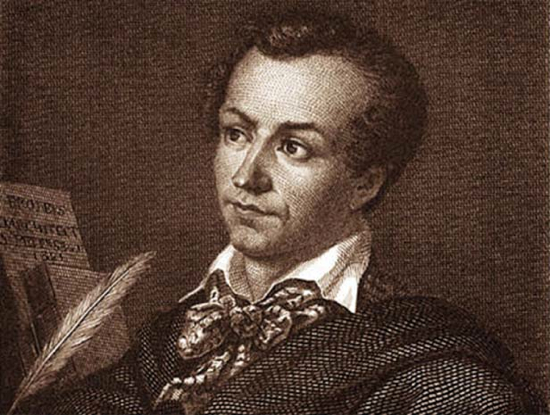
Antonin Carême was, how do you say in your country, a very interesting fellow. Yes, he may have been responsible for vol-au-vent, Napoleons and other pastries we know today, but these are only a sneeze in ze bucket when you consider what he did not just for French food, but for European cuisine as a whole.
Carême’s is a classic rags-to-riches story that just happened to take place during the French Revolution. He was born into a Parisian family which by some accounts had 25 children. Being the only smart one of the bunch, he was kicked out of the house at age ten, ostensibly because a peasant household with two dozen kids was no place for a person with brains.
He landed in what we moderns would call a “greasy spoon” where he worked for room and board for seven years. Somehow he was noticed by the preeminent pâtissier of the day, Sylvain Bailly, under whose tutelage he distinguished himself as a maker of pièces montées that decorated the banquet tables of the period.
It was his highly imaginative architectural work that made Carême a celebrity in Parisian society, and caught the eye of one Charles Maurice de Talleyrand-Périgord, known to his friends simply as “Talleyrand.” Here was a fellow who was fascinating in his own right, sort of a Bill Clinton of his day: brilliant and visionary, yet self-centered and ultimately rather unscrupulous. Also, quite a ladies’ man. Talleyrand was an aristocrat and a Catholic Bishop who managed to thrive during the most violently anti-aristocratic and anti-Catholic social upheaval Europe had ever seen. A pretty neat trick all by itself.
Talleyrand went on to become France’s foreign minister, helped engineer the coup d’état that brought Napoleon to power, and became one of Europe’s most influential diplomats. Napoleon, of course, soon fell, though that was by no means the end of Talleyrand. In fact he negotiated on behalf of France at the Congress of Vienna following Napoleon’s defeat and eventually helped restore the deposed Bourbons to the French throne. He was, you might say, the consummate political survivor. He died of old age, tremendously rich and with a reputation as one of the greatest diplomats to have ever lived. His former home in Paris is now the US embassy.
So where was I? Oh yes, Carême. Talleyrand had a huge influence on Carême, whom he tasked with creating an entirely new, post-Revolutionary French cuisine. Why was this important? Because the French Revolution marked the beginning of the end for the great aristocratic club that was Europe. Though the French Revolution was fundamentally different than the American Revolution, certain currents were the same: civic institutions over hereditary rule, law over privilege, personal property rights over patronage. Even after the fall of Napoleon and the Bourbons were restored to power, most of these ideas endured, leading to reforms and the fall of monarchies around Europe.
So where was I? Oh yes, Carême. Talleyrand, big-picture fellow that he was, recognized clearly that the face of Europe was changing. And if the face of Europe was changing, so must the food that fed that face. He therefore tasked Careme with creating a new cuisine that was more…how would you say it…”people friendly.” That is, he wanted a cuisine that was simpler and less flamboyant than that of the old aristocracy, that focused on ingredients instead of elaborate techniques, vegetables instead of meat, and that emphasized seasonality. Sounds a bit familiar, eh?
Carême succeeded brilliantly with a stripped down seasonal menu that caused a sensation among the European statesmen and aristocrats that dined at Talleyrand’s table. Upon leaving Paris, these diplomats implemented aspects of the new food aesthetic in their homelands, transforming the way the upper classes (as well as the emerging middle classes) ate. Not too shabby for guy who started out as a peasant with 24 sisters and brothers, eh?
Ahhh… my hero.
oh yes, please. Give us some more!!
Merci pour ce visuel de Careme et son role!
Jusque la j’aurai pense avec un verbe: vole au vent, mais l’auteur prefere apparemment sans l’e – “vol au vent” – encore plus léger!
Thank you, reesink…my French is not very good!
– Joe
vol-au-vent ou vole au vent?
merci bravo bon appetit
Good question, we say “vol au vent” but that may not be correct!
Thanks reesink!
– Joe
I recently learned about Carême in a recent documentary on the history of patisserie that Michel Roux Jr made for the BBC. If you can track it down over the pond, I thoroughly recommend it, if only because M. Roux Jr’s Anglo-French accent highlights what a wonderfully cromulent name “Carême” is.
Go on… say it…
“Carême”
Satisfying, isn’t it?
I’ll look for it, Hellyweg!
And I’ll practice…“Carême”….“Carême”…..
– Joe
Continuing our French lesson, I have looked in several French dictionaries which I own and see no entry for “vole-au-vent”.
I can only find the term I am familiar with, which is the supposedly “lighter” one without the extra “e”, namely “vol-au-vent”. “Vol” means flight” or the homonym “vol” means “theft”, and another homonym “vole” refers to some kind of play in card games. Now,back to baking.
Hello, Pere!
I often hear it translated literally as a “flight of wind” for that reason, but “gust of wind” is I think more to the point. It speaks better to the lightness where is really the whole idea of the thing, no?
Thanks for the comment!
– Joe