Rumford Low-Sodium Baking Powder
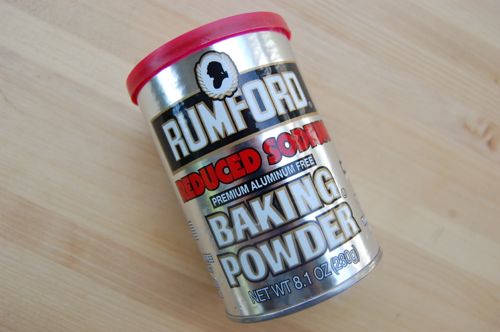
I recently received a press release about this new product from Rumford (really Clabber Girl, which now owns the Rumford brand). I was interested by it since I get regular requests for low-sodium recipes, and the good folks at Clabber Girl were happy to send along a sample for me to try. Though I have yet to test it comprehensively, I did use it for biscuits (American biscuits) last night. Biscuits are an excellent proving ground in our household because I make them once a week on average. Mrs. Pastry and the girls pick out deviations from the norm with spectrographic sensitivity.
I mixed up a batch with the new baking powder, set them down on the table and watched for reactions. The girls carried on mostly as usual, save for one curious, momentary glance from 7-year-old Josephine at the crumb of her biscuit. 4-year old Jo gobbled hers down without hesitation. The only comment came from Mrs. Joe Pastry, who remarked — politely — that the biscuits were a little denser, a bit more moist than normal. Had I baked them long enough?
Those were my thoughts exactly. Flavor-wise the biscuits were very, very close to my standard versions (they were only very slightly bland compared to normal). However there was a texture difference. The biscuits rose impressively, nearly as high as usual, but the crumb was a bit more compact, and that at least gave the impression of extra moisture. Was it dramatic? No, not at all. I’d guess the reduced sodium product delivered biscuits that were 85% close to standard.
That’s quite impressive when you consider that it delivers 52% less sodium than traditional baking powder. If I were on a low-sodium diet and someone handed me a biscuit like I ate last night, my response would have been: “wow.” Considering how rare low-sodium chemical leaveners are on store shelves (products that work well are rarer still), that Rumford chose to invest in product like this is a serious boon to people on low-sodium diets. It’s a major technical achievement.
Weird! I’d be interested to try it but the chem geek in me is like “That doesn’t make sense!” It’s like saying H2O now with half the Hydrogen!” I wonder what they substitute in?
The ingredients list is: calcium acid pyrophosphate, cornstarch, sodium bicarbonate, potassium bicarbonate, monocalcium phosphate (made from non-genetetically modified cornstarch).
Sodium bicarb and potassium bicarb are old-as-the-hills chemical leaveners. And mono calcium phosphate has been used in baking powders for years. It’s the calcium acid pyrophosphate that’s new, and it’s something I’m completely unfamiliar with.
The calcium acid phosphate is the acid part of the baking soda (the name kinda gives it away ;)), as they are making this aluminium free as well as low sodium. They must have bumped up the potassium bicarb to lower the sodium though, if it performs almost the same then chemically it must have almost the same amount of bicarbonate, whatever the form.
Calcium acid phosphate also has different chemical reaction properties (I’m guessing it has a higher reaction enthalpy) so will perform differently to the sodium variety.
Interesting article from 2005: Clicky clicky
Thanks Chris! Great stuff…
This is really helpful info. Thanks for posting it. Have you used both of the Rumford baking powders? Do you find them to behave differently from each other? I read that the standard one has a different ingredients list: Monocalcium phosphate, baking soda and cornstarch. (Reduced sodium version has: calcium acid pyrophosphate, cornstarch, sodium bicarbonate, potassium bicarbonate, monocalcium phosphate.) Would love to know your experiences with both if you’ve used them.
Last week I decided to switch to aluminum free after finally figuring out where the bitter metallic taste was coming from in some baked goods that I made with standard (aluminum) baking powder. Unfortunately, the only kind of aluminum free baking powder I could find was the Rumford low sodium variety. Now that I’ve read your post saying the results were a little bit heavy – I’m worried I should not bother using it, but seek out something else. That’s why I’m so curious if the regular Rumford is better for loft and lightness. I have no sodium problems. Thank you in advance.
Hi Lynn!
Yes, baking powder does have that aftertaste, which can be distracting depending on the recipe. My own experience with the low-sodium is that it doesn’t work quite as well as the standard, but you should try it yourself and see. It may perform better for your recipe than it did in my biscuits!
Best of luck!
– Joe
Thank you, Joe! I’ll let you know how it works out.
Please do, Lynn!
– Joe
Hi Joe, Time for that update. I’ve baked twice with Rumford Low Sodium and twice with a home-made single acting baking powder (cream of tartar, baking soda, cornstarch). Neither are working nearly as well as my former baking powder – aluminum based Calumet. These alternatives are said to need to get into the oven asap – and I’ve done that. I’ve mixed the dry ingredients separately, then made sure the oven was preheated before doing the final mix of dry to wet ingredients – the fling into oven quickly. The Rumford Low Sodium looked like it would be fantastic for a while in the oven – because the cake and brownies got massively lofty – but towards the end of the bake (25-30 mins at 350 or 375) the baked goods did a lot of settling down. Not terrible, but I’m not proud to serve them either. The home-made was far worse. In the cake, there was enough other levening going on that it was salvagable for eating – but it should have been much loftier. The brownies with the homemade baking powder acted like there was NO baking powder at all when finished. (They baked high and violently bubbly like a volcano – then crashed down flat.) Highly disappointing. I might try that Bakewell brand if I can find it. On the positive side – there was NO bitter taste in anything baked free of aluminum. :-\
Lynn!
Thanks so much for the testing notes, they’re going to be extremely valuable to the readership here. You’re a gem!
– Joe
PS: I should have mentioned that the items baked with Rumford Low Sodium were very edible. The cake in particular was very tender, possibly more tender than when I make it with my old baking powder. (I’ve made this same cake recipe for many years.) It only bothered me that it lacked high loft – but after thinking about it, maybe it is a reasonable trade. Tender and moist with no bitter taste might be an acceptable trade even if I do lose some loft.